Showing posts with label World War I. Show all posts

Thursday, May 10, 2018

Bovina's First World War One Fatality - Clark G. Miller

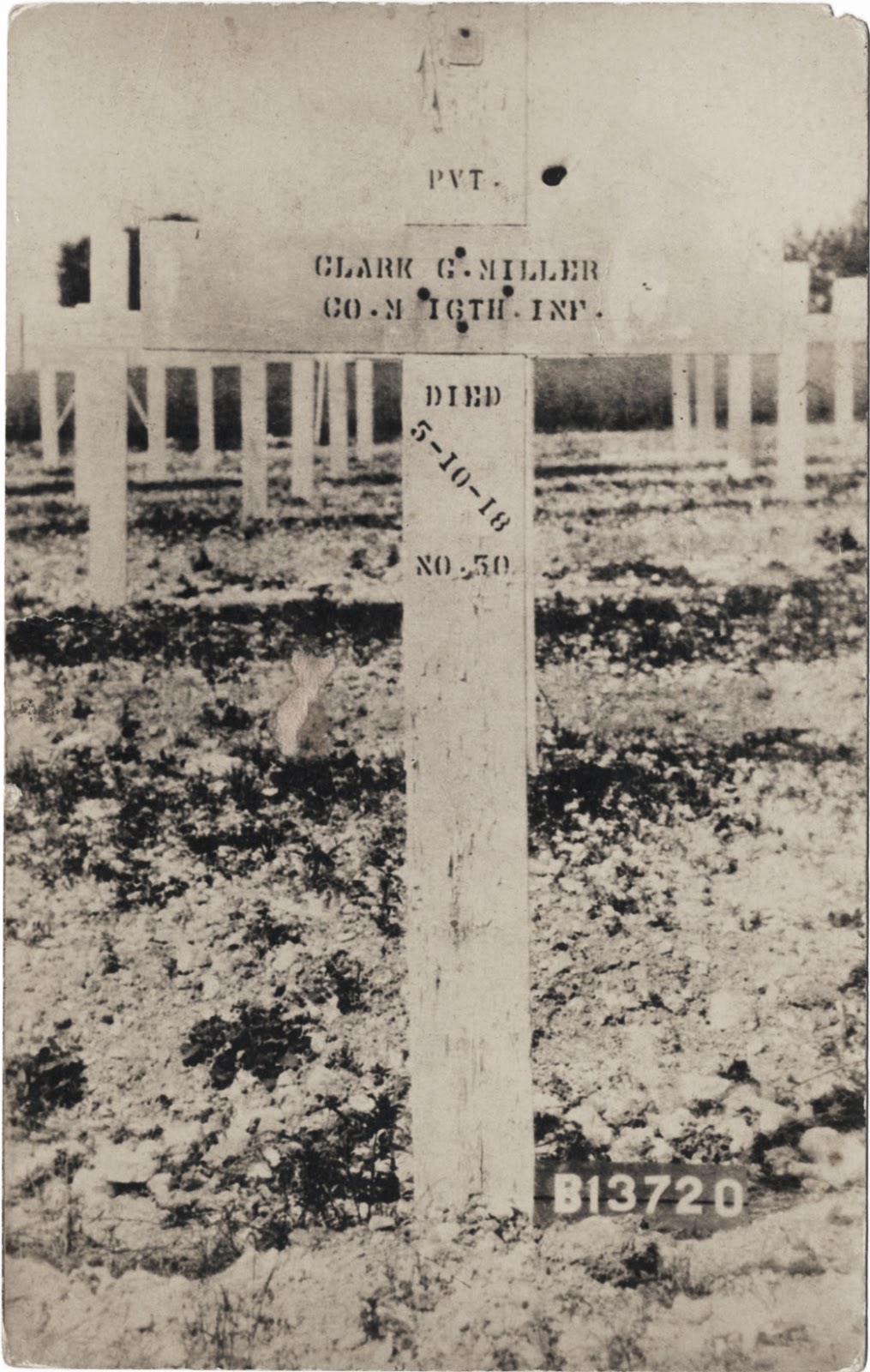
Many of you probably remember Clark Lay and his Indian Motorcycle. Clark use to get it out for parades and such events. The motorcycle originally belonged to his uncle, Clark G. Miller. Miller was killed in action in France 100 years ago today on May 10, 1918. 

Clark was the son of George Miller and Ida E. Kinch. He was born in August 1894 and had two older sisters, including Maude, who married Rev. Charles Lay and was the mother of Clark Lay. He grew up in the house that was later the home of his nephew Clark. 

In December 1912, he made the local papers when he was shot in the leg while rabbit hunting. The December 6, 1912 Bovina column of the Andes Recorder reported the story:

Last Thursday Clarke Miller...was shot in the leg by a companion while hunting. Miller, in company with John Blair, Frank Myers and a Mr. Weeks went rabbit hunting. They found a hole and Mr. Rabbit was routed out by the use of a ferret, and three of the hunters fired. Weeks fired a minute later and from his position made a crossfire and fourteen shot from the charge struck Miller – 11 shot entered the leg just above the knee, one struck him in the arm and another struck him on the chin and taking a downward course lodged in the neck. Miller was taken home and altho still confined to the house is improving. He will always carry the shot in his leg.

Miller bought the Indian Motorcycle in 1914. On June 2, 1917, Clark enlisted in the army in Newburgh, NY. When he went off to war, he asked his father to take good care of his motorcycle. 

Miller arrived in France in November 1917 as part of the 16th Infantry Regiment. Miller was killed in action during the defense of Paris. The family received word at the end of May of Clark's death. A memorial service was held in Bovina. The Andes Recorder noted that "a large number from Delhi and other villages attended the memorial services...Forty of Sheldon Rifles from Delhi, and our firemen attended in a body." In July, Mrs. Miller received a check for $1,000 as payment on her son's insurance policy. 

Miller originally was buried in France. Three years later, his body was disinterred and shipped back to the United States. He was buried in the Bovina Cemetery at the end of March 1921.


Clark's grave in France. Thanks to Ken Wilson for supplying this postcard.


The August 4, 1918 New York Tribune had a page remembering a number of New York soldiers who had been killed in the War. Clark Miller's picture was included (second row far right) as well as that of Quentin Roosevelt, the son of former President Theodore Roosevelt. 


Clark Lay in 1976 with his Uncle Clark Miller's Indian Motorcycle.

Friday, April 20, 2018

Grandma's First Husband - "Have reached my destination safely and am well."

In April came the last big change in James’ location. Around April 5, he set sail for France, arriving on April 15.

Anna received 36 letters from James while he was in France.  She tracked the arrival of all the letters, as well as his allotments and other items on this card.  

The first item she received from James was this simple card that simply stated “I have arrived safely overseas” along with his signature.  Anna received the card on April 22 (an identical card also was sent to his mother).


The letters James wrote from France came to Anna sporadically, and often not in sequence.  For instance, his letters of June 5 and 11 arrived 8 days after the letter of June 16.  On average they took about a month to arrive.  Anna’s letters to James seemed to have taken also about a month, though in his last letter, written September 23, he noted just receiving Anna’s four letters written between July 3 and 19.  Her later letters written in late July and early August were received by James in early September.

The main thing one will notice with the letters is that they don’t tell too much about what James is doing, particularly where he is located.  The letters do comment on things going on in Anna’s life, though the early letters don’t even do this. As James noted in his first letter, “I can learn better what to write after more experience.” All the letters have a statement and signature from the censor approving them for mailing.
 
No letters from Anna to James survive from his time in France.

The first letter he sent from France is not dated but was received May 4.


My dear Anna;

Have reached my destination safely and am well, except for a couple of days of sickness have been well since I came from home.  My cold is much better and have but little cough now. 
You will have gotten a card telling of our safe arrival some time before this letter reaches you so I know that you will not feel worried because I have not written for some time.  When I was home I felt that you knew where I should be sent next so I said very little about it as I knew it would only be harder for you.
For reasons that you already know we are not permitted to tell where we are but can tell you enough to let you know that we are prospering fine. 
The weather has been nice all the time of which I for one was very glad.  Every protection is given us and I must say we are well provided for and feel that every precaution is being taken for the preservation of the men although we no doubt will have to work hard here which is quite right under the circumstances.
I will not make my letters long as the censor may tire reading same and feel like discarding them but do not feel bad because I write little because I think of you often and perhaps I can learn better what to write after more experience.
Address my letters Co ‘D’, 7th Inf, A.E.F.
Your most loving husband,
James
PS - I await a letter from you very anxiously.  JDC.

Second letter, postmark may read April 26, received May 9

Somewhere in France
My dear Anna;

You will think I have forgotten to write but such is not the case.  I have been moving and have not had an opportunity.
I know you will be very anxious to hear from me so I am writing at the first opportunity and think I shall be able to write more often since I am settled for the present.  I hope to get a letter from you soon which I anxiously await.  I am feeling very good now and do not tire easily.  My cough has nearly gone. 
I have the privilege of having access to a YMCA which I appreciate very much.  This is a beautiful country indeed and it seems good to see vegetation so green.
I am not very wise yet as to material which I may write but will soon get a few ideas after a little more experience.
I am wondering what you people are doing these days but I can imagine how things are there.
I can readily see how different are the customs of the people here from at home.  I have little success speaking their language and consequently have not tried but little to talk to them.  Everything seems very different but expect I shall simply have to adjust myself to conditions.
I hope to hear from you before very long.  Please write often.
Your most loving husband,
James

The next two letters arrived the same day, May 20.

Somewhere in France
April 24, 1918

My dear Anna;

I will start another letter on its way.  I will try and send one every few days.
Everything is all O.K. and am getting along nicely.  Am feeling fine and feel that the steady work is doing me considerable benefit.  Am trying to get a good grip on my work but you know how hard I am to get into shape.  I have hopes however and feel that I shall get over my blunders in time. 
The weather is damp and all forms of vegetation look fine.
The language seems very different from ours but know that ours appears just as strange to them.
The weather must be warmer with you now and expect the country there is just as beautiful as here.
I ate the last of the maple sugar this morning and of course wished there was more.


I am interested in my work and as I feel fine I know I shall feel fine.  I cannot afford to be discontented and neither can you.  I have a work to do before I come again.  I know you will understand.
Please write often.  Your most loving husband, James.

Somewhere in France
April 27, 1918

My dear Anna;

Wills send you a few lines today to let you know that all is [well].  I am also sending you a little surplus valuables that I had here.  I am anxiously awaiting a letter from you and expect to get one before very long. 
I have written but few letters; have sent them to you and mother only.  I know that you will let Cora, Anna [his sisters] and the others know that I am O.K.  Tell the people to write me and try to let them know how I shall appreciate a few lines from them.
I expect you are finished with the maple syrup but there is not doubt many other pieces of farm work demanding attention.  I feel that it is good that I can keep busy enough to keep my thoughts from wandering too far away as they surely would otherwise.  Do not think that my thoughts do not come across to you because they do every day as I know yours do of me.
Please notice when the next premium is due on my insurance policies.  I believe there is a semi annual payment due on one Aug. 3 and a yearly payment due on the other October 3 or about that time. 
Now that you know the situation please write as often as you conveniently can.
Your most loving husband, James  

The last letter he wrote in April took over a month to get to Anna.  She didn’t get it until June 7.  Three later letters written in early May all came before this one. 

Somewhere in France
April 29, 1918 (postmark May 19)

My dear Anna;

I am writing you a few lines this evening to let you know that all is O.K. with me.  There are many things I should like to write to you about but since I am not permitted to do so will have to wait until I can talk to you personally.
I was at services yesterday and it certainly did seem good to hear the preacher voice again.  I expect I shall be able to get to services nearly each week.  We are fortunate enough to have an ordained minister with us at all times.
I expect the weather will be getting warmer with you now and you will soon be all busy getting the crops soon.  Am afraid I shall almost forget how to care for horses and cattle but am sure I could learn the art by brushing up a little. 
When I get a letter from you I shall be able to write you better letters than at present.  Letter writing is much easier when the letter in question is in answer to one already received.  I could ask many questions but I know that is needless as you will write me a letter of general information.
Your most loving husband, James
F.S. Long [Censor]

Tuesday, November 14, 2017

Grandma’s First Husband – The Story of Anna Bell Barnhart and James D. Calhoun

I remember when I first learned that my paternal grandmother had been married before. I think it was in July 1969, so I would have been 14. We were visiting my grandparents at their home near Massena, NY, going through family pictures. I came across this school souvenir, which included on the cover a photograph of the teacher, James D. Calhoun. I asked Grandma who this guy was and she said, ‘that’s my first husband.’ The news startled me. I didn’t known about grandma’s previous marriage. While she was alive, I didn’t pursue this, though when I first asked her about him she said he was a wonderful man. She still missed him more than 50 years after his death.

Biggar Hollow school souvenir, 1910
I learned much more about grandma’s first husband after her death in March 1980. We found a tin box that held letters Anna and James exchanged during their brief marriage. The letters were turned over to me (and will eventually go to the Delaware County Historical Association).

Grandma's First Marriage

One hundred years ago today, on November 14, 1917, Anna Bell Barnhart married James Calhoun. The marriage would last eleven months, ending with the death of James on a battlefield in France on October 13, 1918 (see the entry in this blog for November 11, 2010 for more about his death). Out of the 11 months of their marriage. James and Anna Bell would spend about 11 days together. Anna Bell was widowed over four years when in May 1923, she married my grandfather Benson LaFever in Bovina. My grandparents lived in Bovina until the 1950s, then moved to Northern New York, where they lived until her passing in 1980 and his in 1982.

Over the course of the next year, I will be sharing selected transcripts of the letters my grandmother and her first husband exchanged while he was in the army. The bulk of the letters are ones written by James during his service, but some of grandma’s responses survive, three from December 1917 and a group from March 1918. The reason more of her letters did not survive was because, as James frankly admitted in a letter to her, he destroyed most of her letters to protect their privacy. The letters have their personal elements but also give an idea of what was happening in Bovina during the war.

Background

James Calhoun was born in Andes, New York, on December 3, 1889, the son of Daniel Calhoun and Cornelia McNair.  He was one of seven children born to Daniel and Cornelia. He taught for a year in the Biggar Hollow school (1909-1910) before moving to Iowa. About a year later, he went to Colorado and then came back to Iowa around 1913 before coming back to Andes for good in 1914. He became the area’s milk tester. It likely was through this job that he met Anna Bell Barnhart. Anna Bell was born November 7, 1893, the daughter of Jeremy Barnhart and Kate Miller.  She had an older brother, Ralph and was joined in 1897 by a sister Edith and in 1901 by a brother, Wilford.  She grew up on the family farm on Pink Street, going to the local school through the 8th grade. 

Early Letters

There were only three letters from James and none from Anna in her papers dated before their November 14 wedding.  The earliest letter from James is dated September 1, 1917, Bovina Center.  It probably was addressed to Anna, but it’s addressed ‘Dear friend.”  The letter continues:

     I received your invitation to the picnic when I came over from home yesterday (Friday).  I was disappointed when I did not get word in time so I could attend.  It was very kind of you to invite me and I would certainly enjoyed going. 
     I have received notice from the local army board at Delhi to be prepared to report for duty on 24 hours notice.
     Very sincerely, James

The fact that James was facing the draft would be a factor during their courtship.  The next letter from James, dated September 29, 1917 from Delhi discusses this further:

     The Drafted men chosen to go to camp Dix at this time are all present except one. Another young man, who is very anxious to go at this time, has been chosen to go in my place so I shall not go until the remainder of the boys leave. 

The last letter from James to Anna before their marriage in my grandmother’s files is brief, written in Bovina on November 7, 1917:

Dear Anna;
      Father died this morning. I am on my way home. Lay your plans as you previously intended. I cannot tell when I shall see you but will sometime the last of the week.

Lovingly, James

James’ father, Daniel, died unexpectedly.  The local newspaper reported that Daniel had not been sleeping well, so “he got up to sit in his chair and a little while later his wife found he had fallen from the chair and lay dead.”  The same newspaper in the Bovina Center column reported that a “large number of Bovina folks motored to Andes for the funeral of Daniel Calhoun.” The funeral was held on Saturday, November 10. Anna and James’ wedding took place the following Wednesday. [Anna Bell's father, Jeremy, had died on November 6, 1916, a year and a day before the death of Daniel Calhoun.]

The Wedding

One of the earliest letter of congratulations concerning Anna’s and James’ impending wedding in my grandmother’s files was written by her Aunt Maria Barnhart Albee from Unadilla, her late father’s sister. The letter is one of my favorites. She references the fact that at age 24, grandma was considered to be a bit ‘old.' The letter also notes the recent passage of women’s suffrage in New York State.

Dear Annabell:
Well you sly thing you - well - well and so you have decided not to be an “old maid” after all, and you can vote too.
I am not going to write very much because just to be real mean I am or we are going to come if the roads stay good.  We have never gotten any chains yet…We are going to hope for a dandy day - we have thought of coming up there ever since we got the car but the rain and fall work have just spoiled things for us.  I wanted to come to return that loaf of bread, but I shall not bring it this time.
I am enclosing a little something for you from Uncle Charlie and I and Grandma.  Charlie didn’t spell your name like you spell it but I don’t believe you will have any trouble getting it if you endorse it the same. 
I thought I would send it so if the weather was bad you would have it any way.  We probably won’t come unless the day is good also the roads.
Wishing you both a long happy life, I am with love,
Aunt Maria

A note on the spelling of my grandmother’s first name. It was misspelled constantly during her life - it was Anna Bell (no second 'e'). It was wrong in the news reports of her wedding and even on her own wedding invitation and, later, on the tombstone erected for her and her first husband in the 1920s. You may notice as these entries are presented that James always called her Anna, but everyone else called her Anna Bell. That’s how I always heard her called, including by my grandfather. In letters to his family, James usually refers to his wife as Anna, though in one instance, he did say Anna Bell. She signed her letters to him as Anna and to his family as Anna B. Calhoun. (James had a sister named Anna, adding somewhat to the confusion in reviewing these letters.) 

Anna Bell Barnhart was married to James Daniel Calhoun on Wednesday, November 14 at noon at the home of Anna Bell’s mother, Kate Barnhart, on Pink Street (the farm now owned by the Glavins).  As reported in the local newspaper, the “ceremony was performed handsomely by the Rev. Forbes of Andes, assisted by the Rev. Thos. E. Graham of Bovina.” Anna’s sister Edith was her bridesmaid and George Storie was the best man for his friend James. “The bridal couple left about 3:30 in the handsome Cadillac of Andrew Doig, to spend a few days visiting some of our larger cities.” 


James Calhoun and Anna Bell Barnhart on their wedding day.


Here's the barn that was behind James and Anna Bell's wedding pictures 100 years later (thanks to Michael and Lori Glavin for taking such good care of it). 
Getting ready for the group photo (which unfortunately did not turn out well)

To James right is his best man, George Storie. On Anna Bell's left is her sister Edith
The Honeymoon

The newspaper noted that James and Anna Bell were to visit some cities, but from my grandmother's photo album, I can see that they also went to that Mecca for honeymooners in that era, Niagara Falls. Here are three photos from that trip.


James is Drafted

Nine days after his wedding, on Friday, November 23, 1917, James left Delhi with a group of thirty-two men.  The local paper reported that “all these men will be presented with a box lunch by Delhi people and with a comfort set by the Red Cross, which includes sweater, wristlets, etc."

James’s first letter to Anna after heading into service was written the evening of his departure on a 3 x 5 card:

Allentown, PA
Nov 23, 1917

Dear Anna,
We have just passed through Allentown.  It is 7:00 oclock and suppertime.  Most of the fellows seem happy.  Some of them seem like good fellows and some of them swear like real troopers.  The train people served dinner to all the boys and are now serving supper. 
Frank Munson and Leslie Cameron are the only fellows I have ever met before.
I felt very sorry for Frank but he is making the most of it.  Hazel will feel badly.  I am thinking very tenderly of you.
With love James


Frank Munson's name will show up frequently in James' early letters. 

The story of my grandma's first husband will continue next month in this blog. 

Sunday, April 23, 2017

Centennial of US Entry into World War I

On April 2, 1917, President Woodrow Wilson asked in a joint session of Congress for a declaration of war against Germany. Congress declared war on April 6, bringing the United States into the Great War.

Bovina would lose two men in the war. Clark Miller, uncle of Clark Lay, died in April 1918. James D. Calhoun, my grandmother Anna Bell Barnhart's first husband, died in October that same year. A third man, Clarence Lee, would die in 1922 from injuries received during the war.

I plan over the next few months to report on some of Bovina's soldiers from the Great War - I'm still working on creating a list of all of Bovina's World War I vets. So far, I have a list of 38 men. It may grow (or even shrink) as I verify these.

Some past blog entries about the war:

I did one in November 2010 about my grandmother Anna Bell Barnhart's first husband, James D. Calhoun: http://bovinanyhistory.blogspot.com/2010/11/james-calhoun-and-great-war.html. I will be starting a new blog in November sharing some of the letters my grandmother and James exchanged during their 11 month marriage.

James D. Calhoun (1889-1918)
This is James's service information from the New York State Abstracts of World War I Military Service, 1917–1919. Adjutant General's Office. Series B0808. New York State Archives, Albany, New York.
In March 2011, I reported on the death of the last World War I vet and noted that Fletcher Davidson was Bovina's last surviving World War I vet. http://bovinanyhistory.blogspot.com/2011/03/last-vet-of-great-war.html. I've since realized that Bovina had at least one vet who survived Fletcher - Donald Lee died in 1995 at the age of 99.

H. Fletcher Davidson (1895-1987)
This is Fletcher's service information from the New York State Abstracts of World War I Military Service, 1917–1919. Adjutant General's Office. Series B0808. New York State Archives, Albany, New York.
These cards are accessible through Ancestry.com and through the New York State Archives website.


Wednesday, March 2, 2011

The Last Vet of the Great War

Frank Woodruff Buckles, the last surviving veteran of the First World War, died on February 28 at 110. I thought this was an appropriate moment to briefly talk about Bovina's veterans from the Great War. I haven't created a definitive list of these soldiers (I'm still plugging away on such a list for the Civil War) but there are 21 men buried in the Bovina Cemetery who served in the War. Two of the men died in the war. Clark G. Miller died in May 1918, killed in the defense of Paris. James Calhoun was killed in action October 1918 (see my blog entry of November 11, 2010 about James). Both men were originally buried in France but their bodies were shipped home in 1921 for burial in Bovina.

The 19 other soldiers in Bovina's cemetery survived the war, but two of them died in the 1920s. Frank Munson was drafted in the war and started basic training. He was friends with James Calhoun and is mentioned often in the letters he wrote home to his wife, Anna Bell (who was my grandmother). Some health related issue kept Frank from actually going overseas, much to James' relief. Munson was married in 1918 but he died two years later when a tree fell on him. Clarence C. Lee died in Mount Vision, NY in 1922. He was only 29 years old.

Bovina's last surviving World War I veteran appears to have been one of my predecessors as Town Historian, Fletcher Davidson. Fletcher died in 1987, age 92. See my blog entry of August 23, 2009 for more about Fletcher.

The idea for this blog entry came from a friend and former colleague at the State Archives from her blog at http://larchivista.blogspot.com/2011/02/frank-woodruff-buckles-2001-2011.html. She ends the entry thusly: "As an archivist, I would be the first to argue that the documentary record constitutes an essential, inextricable, vivid tie to the past. It is nonetheless sad and sobering to see the documentary record become the only thing that connects us to a given point in the past." Couldn't have said it better myself.

Thursday, November 11, 2010

James Calhoun and the Great War

November 11 started out as Armistice Day, marking the day that the first World War ended in 1918. There were several Bovina boys who served in the Great War. One of them was James Calhoun. James was born in 1889 in Andes but grew up just over the border in Bovina. On November 14, 1917, he was married in Bovina to Anna Bell Barnhart. That same day, James received his official draft notice. So after only 9 days together, James left his new wife and was shipped off to Fort Dix, New Jersey. After a couple of weeks, he was shipped further south to Camp Greene in Charlotte, North Carolina. In late March, he came home to Bovina for a 30 hour furlough. In early April, he was shipped off to France.

On October 13, 1918, James was killed in action during the Battle of the Argonne. His wife did not find out until a day after her first wedding anniversary - and four days after the Armistice. Below is the telegram she received notifying her of her husband's death. She later was told that the death date in the telegram of October 14 was wrong and that he died a day earlier.

Anna Bell received several letters with further details concerning James's death. One she received in January 1919 reported information provided by James's Captain:

It happened on October 13 near the town of Cunel. The first battalion was about to attack but there were some German machine guns concealed in the underbrush at the right and it was necessary to clear them out before the advance could be made - so Sergeant Calhoun volunteered to accompany Lieutenant Williams and arrived with hand grenades they bravely started to clear the way for their comrades, and it was while doing this courageous thing that the same shell brought them both instant death.


Anna Bell was widowed for four and a half years. In May 1923, she was married in Bovina Center to Benson LaFever. They had four sons, including my dad, Charlie LaFever.

Grandma had saved all the letters she received from her first husband, along with some of the letters she sent to James while he was still in the United States. We also have many of her photographs. This poignant picture of my grandmother has always been a favorite of mine. I think it was taken after James's death and shows her with what probably was the flag that was on James's coffin. Grandma always remembered and honored the sacrifice her husband made - and we also remember and honor the sacrifice she made in the Great War.