Sunday, June 12, 2011

Bovina in the Civil War – Recruiting

As did most communities in the country, Bovina made its contribution to the War of the Rebellion.  Bovina ultimately furnished 94 men, out of quota that totaled 109.  Eleven men volunteered between June 1861 and July 1862.  Another 33 were furnished in the summer of 1862, under the President’s call for 600,000 men.  Six more enlisted in 1863, 24 in the summer of 1864 and 20 enlisted in December of that year. 

Forty two of Bovina’s men in blue served in the 144th New York Infantry Regiment – and most of these were in Company E, which was predominately made up of men from Bovina and Andes.  The 144th was created in 1862 after President Lincoln issued a call for an additional 300,000 men. New York Governor Edwin D. Morgan issued a proclamation for volunteers on 2 July 1862. Originally, the counties of Delaware, Schoharie and Schenectady were grouped to form one regiment, but a rally held on August 6, 1862 in Delhi was so successful that Delaware County raised enough men for an entire regiment. Robert S. Hughston was appointed Colonel.

As the war progressed and President Lincoln issued more calls for soldiers, more enticements were needed to get young men to enlist.  In the fall of 1863, the President issued a call for 300,000 men, followed a few months later by a call for 200,000 more.  Communities were given a quota which they had to meet through enlistments or the hiring of substitutes.  The men did not have to be from the community in which they lived - towns could meet their quota with any willing and able volunteer.  To entice soldiers to enlist, communities would offer a bounty.  In Bovina, the bounty for 1864, voted on at the end of 1863, was $300, with 112 supporting the bounty and 63 against.  Apparently, this wasn’t sufficient to attract enough volunteers to meet the quota.  In February of 1864, a vote was held to increase the bounty by $100 to $400.  The increase passed but by a tighter margin – 98 for to 85 against.  The amount was raised again in June, but the vote was even tighter, with 68 for and 67 against.  Subsequent votes in August and September to raise the bounty yet again passed by wider margins.  By the last vote in early 1865, the bounty was up to $800.  Bovina raised a total of $42,204 during the war to meet its bounty requirements and other expenses related to the war.  Of that, $39,650 was paid in actual bounties, $807 for recruiting fees and $1747 was paid for interest on town loans.   

When enlistments still lagged, a draft came into being.  Even before the Civil War, all men between 20 and 45 were required to enroll as being eligible for military service.  Bovina had 188 men who were on this list.  It was from this list that the names of draftees were drawn.  Bovina had a quota of 22 men to be furnished under the 1863 draft, with another 6 in March 1864.  Out of these 28, 26 did not have to go because they paid $300.  One draftee, Reverend John E. Taylor, was the pastor of the Cabin Hill Presbyterian Church in Andes (and later the Presbyterian Church in Delancey).  Taylor, a Bovina resident, furnished a substitute.  

Bovina appears to have had at least one draft evader.  The final report on Bovina's participation in the war noted that one of the 1863 draftees absconded.  The name was not provided, but circumstantial evidence points to Elijah Fuller, the son of Richard Fuller and Ann Nichols.  First, there is no information about Fuller's status in the draft documentation (it is provided for all other draftees).  Second, he does not show up in any future New York or Federal census records.  Third, he does not show up in the 1864 or 1866 military roll (he was on the 1862 one).  Fourth, he does not show up in any New York Civil War service (though, of course, he could have served in another state).  Fifth, and the strongest piece of evidence, is that Fuller moved to Canada sometime in the 1860s and stayed there the rest of his life.  He married Eva Metland in Canada in 1867.  All of his children were born in Canada and he died there in 1918.  Going to Canada to avoid the draft did happen in the Civil War.  It is possible that Fuller took this action to avoid the horrors of the war. 

Young men in Bovina took a variety of paths during the Civil War.  Some went to war eagerly, some reluctantly and some, for various reasons and using various approaches, such as Elijah Fuller, opted not to serve.  In July's blog entry about the war, I'll talk about Bovina's 33 men who claimed exemption from service.

Wednesday, June 8, 2011

Delaware Railroad Company - Follow-up

On June 4, I attended a talk and book signing by Dr. Michael Kudish for his new book, Where Did the Tracks Go in the Catskills?  It's the fourth volume in his series called Mountain Railroads of New York State (available from Purple Mountain Press).  As Mike emphasized in his talk, the focus of his series on railroads is on the geography, not the detailed history of the railroads themselves.  His series covers railroads that were built and those that were only partially built and never completed.  One of those uncompleted railroads was the Delaware Railroad Company - the strongest attempt to bring the trains into Bovina.

I've reported on the Delaware Railroad Company, created in 1898, in several blog entries.  I reported on Mike's work to identify where the rail bed was located in entries on May 12 and November 8, 2009 and April 26, 2010.  This past March, I did a four part series about the railroad.

Just this month, Tom Hilson shared with me a recently unearthed cache of materials in his family papers related to the railroad.  The materials included the prospectus for the Delaware Railroad Company.  He also has lists of subscribers for buying the right of way and lists of stockholders (which I will share these in future blog entries).  Here's the text of the prospectus.  Note that the prospectus calls the railroad the Delaware Valley Railroad, though that is not the name that was in the incorporation papers. 

Delaware Valley Railroad Prospectus

   The proposed DELAWARE VALLEY RAILROAD is to be built from the village of Delhi, the county seat of Delaware County, N.Y., from the terminal for the Delhi branch of the New York, Ontario & Western Railroad, to the villages of Andes and Bovina Centre, a total distance of 15 miles.
   The consent of the property owners along the line has all be secured, permitting the construction of the railway along the highway, or the so called Delhi and Middletown turnpike.
   The villages of Andes and Bovina Centre have no outlet to a railroad, the nearest being 12 miles over a long and steep hill to the Ulster & Delaware Railroad, at Arkville, or 12 miles to the New York, Ontario & Western Railroad, at Delhi, over this proposed route.
   The people for at least 7 miles beyond Andes will haul freight to and from the proposed railroad at Andes.  To reach Bovina Centre, a branch will be run intersecting the main line, reaching people for at least 7 miles beyond Bovina Centre who will haul freight to and from this terminus, making the length of territory covered by this railroad over 30 miles. 
   The territory to be covered by this railroad is as fertile as any in the State of New York, and a noted dairying section.  The milk and freight traffic on this proposed railroad will be a large and profitable one, and the company will at once obtain a large business from this item of freight alone. 
   The proposed railroad follows the Little Delaware, a branch of the Delaware river, and the grades encountered are comparatively easy, costing less than $3,000 per mile in the construction of the road bed.
   We are positive that a personal examination of the route will prove conclusively the correctness of this statement, and the prospective earnings hereto attached, and would invite examination as to the correctness of our statements.
   This statement does not include the villages of New Kingston, Margaretville, Arena, Union Grove, and Shavertown, all of which are within a distance of ten miles from the road. 
The second page of the prospectus provided information on the cost of the railroad.  An image of that page is above. 

I will provide a list of people who bought stock and subscribers to the right of way in future blog entries. Many thanks to Tom for sharing this with me and allowing me to share it with you.


Friday, June 3, 2011

Bovina Honor Roll

During World War II, the Town of Bovina created this Honor Roll of its men and women who were serving in the war.  It stood by the Bovina Public Library (now the Bovina Historical Society museum). The roll was taken down sometime in the 1960s to protect it from the elements.  Below are two pictures that both date from the 1940s. Compare them with each other and with the roll as it looks today and you'll see that names were regularly being added during the war.

Photo from 1940s by James Hoy, courtesy of Jim and Tom Hoy.


Photo courtesy of family of Jack Hilson - click on image to see larger view

Photo by Ray LaFever, May 21, 2011 - click on image to see larger view
Here's an alphabetical list of the names on the Honor Roll, courtesy of Ed Davidson:


HAROLD AITKENS
HERMAN ARCHIBALD
LEONARD ARCHIBALD
LYNN ARMSTRONG
HAROLD BARBOUR
SAMUEL BARLOW
EDWARD BARNES
DONALD BARNHART
HERBERT BARNHART
PAUL BELLINO
JOHN BIGGAR
JOSEPH BIRDSALL
JOHN BURDICK
AMOS CHASE
EDWIN CHASE
LESTER CHASE
FREDERIC COLE
GLENN COLE
KENNETH CURTIS
ALLAN DAVIDSON
EDWIN DAVIDSON
FRANCES DECKER
DONALD DeSILVA
ETHEL DeSILVA
FRED DeSILVA
JACK DITTY
WARREN EITNER
ODE EKSETH
ROBERT ERKSON
FLOYD ESTUS
ROBERT FINKLE
EDWARD GERRY
ELBRIDGE GERRY
HENRY GERRY
ROBERT GERRY
CRAIGHTON GONYO
NOEL GONYO
LeROY GRAHAN
RICHARD GRUNDY
LAUREN HEWITT
STANLEY HEWITT
ALEX HILSON
JACK HILSON
ROBERT HOAGLAND
ROBERT HOY
WILLIAM HOY
DONALD HOYT
RUDOLPH HUNT
EVERETT HYATT
RALPH HYATT
ALLAN JOHNSTON
ARTHUR JONES
RAY JOSCELYN
SYLVAN LaFEVER
CLARK LAY
ROBERT LEE
LAWRENCE LEWIS
ROBERT LEWIS
ROY LEWIS
ROBERT LIDDLE
ARTHUR MAYHEW
DAVID MAYHEW
DONALD MAYHEW
HARVEY McCLELLAN
BOYDEN McCUMBER
CHARLES McINTOSH
FORREST MEADE
ERNIST MILLER
LEORA MILLER
ARNOLD PERRY
BERNARD PERRY
GORDON RABELER
HENRY RABELER
PAUL RABELER
RUTH RABELER
ARTHUR REINERTSEN
ROBERT REINERTSEN
SEGARD REINERTSEN
CLIFTON RUSSELL
EVAN RUSSELL
ARNOLD SCHNEIDER
CARL SCHNEIDER
ALBERT SIMONSON
ADRIAN SLIUTER
ROBERT TODD
CARL TUTTLE
ARTHUR VanALSTINE
HARVEY VanBUREN
WILBUR VanNOOY
THOMAS WALLIS, Jr
PALMER WATERMAN
ROBERT WATERMAN
WILLIAM WILSON
MARCUS YOUNG

I would love to hear from anyone who knows the history of this roll or of the names on it.  As far as I know, there are two people on this roll who are still with us:  Ed Davidson and Stanley (Stub) Hewitt.  If there are others, let me know.  I am pursuing getting funding to stabilize the honor roll and erect it somewhere in town where it can be seen. So stay tuned for further developments. 

Wednesday, June 1, 2011

Bramley Mountain Plane Crash - Quick update

This is a quick note, mostly of excitement, as I continue to research the 1945 plane crash near Bramley Mountain that took the life of a West Point cadet (see my April 29 and May 30 blog postings).  I've established contact with someone in Cadet Clark's hometown of Holdrege, Nebraska and tonight spoke with his sister-in-law - the first person I've had any contact with who actually knew him.  She recalled him being a very nice young man who did well in spite of coming from what was then known as a broken home.  When he came home on leave from West Point, it amused her that he was not very neat during his leave - his clothes were all over the furniture in his room.  It probably was a nice change from what he had to do when at the Academy.  I'm now working to establish contact with some of his high school and West Point classmates. 

So from a simple question in Russell's Store about a plane crash this has grown into quite the enterprise.  More to come. 

Monday, May 30, 2011

1945 Plane Crash in Bovina - Update

In my April 29 blog, I reported on the crash of a military training airplane in the area of Bramley Mountain that took place just days before the end of World War II in Europe.  Since that entry, I have found further information on the pilot - and an error that needs to be noted.

Robert Bragg Clark was born August 9, 1923 in Holdrege, Nebraska, the son of Charles M. and his wife Frances.  He grew up in Nebraska and graduated from Holdrege High School in June 1941, where he had been a member of the National Honor Society, the Debate Team and was in the band.  Clark also was class valedictorian. He was not from a farming family - he was noted for doing small maintenance jobs to supplement the family income, including work on telephone and telegraph lines. Clark's high school classmates, during their 50th reunion in 1991, remembered him as a hard worker with a positive outlook on life.  They expected great things from him.

After winning state recognition for his debating talents, Robert Clark came to the attention of Nebraska's U.S. Senator, George Norris, who appointed him to the United States Military Academy at West Point.  At the time of his entrance on July 15, 1942, he was tall and slim (6 feet, 2 inches and 162 pounds).  Assigned to Company A-1, he became a corporal in October 1943 and was promoted to sergeant in September 1944.  While at the Military Academy, Clark participated in intramural soccer, swimming, lacrosse and squash.  In the spring of 1944, he began training as a student pilot, training in Texas for two months then completing his basic training at Stewart Field in Newburgh in March 1945.  To prepare for graduation, Air Cadets had to accelerate their academic schedule and undergo 60 days of intensive flying to receive their wings on graduation day.  At the time of the plane crash, Clark had 141 hours of flight experience and was close to having enough hours to get his wings.  His training had included 14 hours of flying at night, but he seems to have had barely an hour of experience flying on instruments.  This, along with the very poor weather conditions on April 29, may explain why the accident happened.

The cadet corps was shocked by Clark's death, only five weeks before graduation. In his Cadet Service Record is the following order:

HEADQUARTERS UNITED STATES MILITARY ACADEMY
West Point, NY, 1 May 1945

General orders, No. 10,

     It is the sad duty of the Superintendent to announce the death of the late AIR CADET ROBERT BRAGG CLARK, C-1867, a member of the First Class United States Military Academy, whose death occurred as the result of an aviation training accident near Bloomville, New York, on 29 April 1945 while engaged in an authorized aerial flight from Stewart Field, U.S.M.A., Newburgh, New York

     The late CADET CLARK, a resident of Holdrege, Nebraska, was born in that community on 9 August 1923.  Prior to his admission at the United States Military Academy on 15 July 1942, as a qualified candidate appointed by Senator George W. Norris of Nebraska, the late CADET CLARK had attended the Holdrege High School, Holdrege, Nebraska, from 1937 until 1941, graduating there from and receiving a high school diploma. 

     While at the United States Military Academy, CADET CLARK was an excellent student, standing well in his class and demonstrating a particular proficiency in the academic subjects of mathematics, physics, mechanics, chemistry, electricity, history and government.  He participated in lacrosse, soccer and swimming and was active in those sports while at the United States Military Academy.

     CADET CLARK was in all respects a most estimable young gentleman and a credit to the Corps of Cadets.  In his unfortunate and untimely death the United States Military Academy and the Army Air Forces have suffered a distinct loss.  His courageous death in line of duty and in time of war is most regrettable and is deeply mourned. 

     In conveying my sincere condolences to the bereaved next of kin and to the family and friends of the late CADET CLARK, I am joined by the Commandant of Cadets, by the Commanding Officer at Stewart Field, and by all officers, cadets and enlisted personnel of this command.

                                                                                 F.B. Wilby, Major General, U.S.A.,Superintendent

In an obituary written many years later by Clark's roommates and published in the USMA Alumni magazine, The Assembly, in 1993, they more simply stated "We lost a friend and roommate!"

The error I need to note is the statement in my previous blog that Clark was from Norton, Kansas.  Almost all the newspapers reporting the crash made this statement, but information from his cadet file that I received from the USMA archives and in the alumni magazine clearly state he was from Holdrege, Nebraska.  Some of the papers said that Clark's father, Charles M. Clark, was from Norton, which was true.  As the information circulated around, it appears some papers made the assumption that Cadet Clark also was from Norton.  Clark's father appears to have been moving around.  He was a grain dealer in Boone, Iowa when his son joined the academy in 1942.

I would like to close this entry with a photograph - this is Cadet Robert Bragg Clark from the 1945 Howitzer, the USMA yearbook.  And here is the brief bio that accompanied the picture: "West Point was like a new strange world to Bob when he first entered. He was never one to complain. He took things as they came, for to be disheartened was not part of his nature. His cheerfulness in everything he did won him many lifetime friends. Bob was a very conscientious worker but had no intentions of setting aflame the academic world. Cheerful, efficient, generous, loyal, Bob was a good wife [ie., roommate] and a better man. Good luck to you Bob, in your Army career."

Clark was buried in the cemetery at West Point on May 2, a bright spring day, with all of his cadet company in attendance.  Though he did not die in combat, his death was in the service of his country.  So it seems appropriate to remember him on Memorial Day.

Friday, May 27, 2011

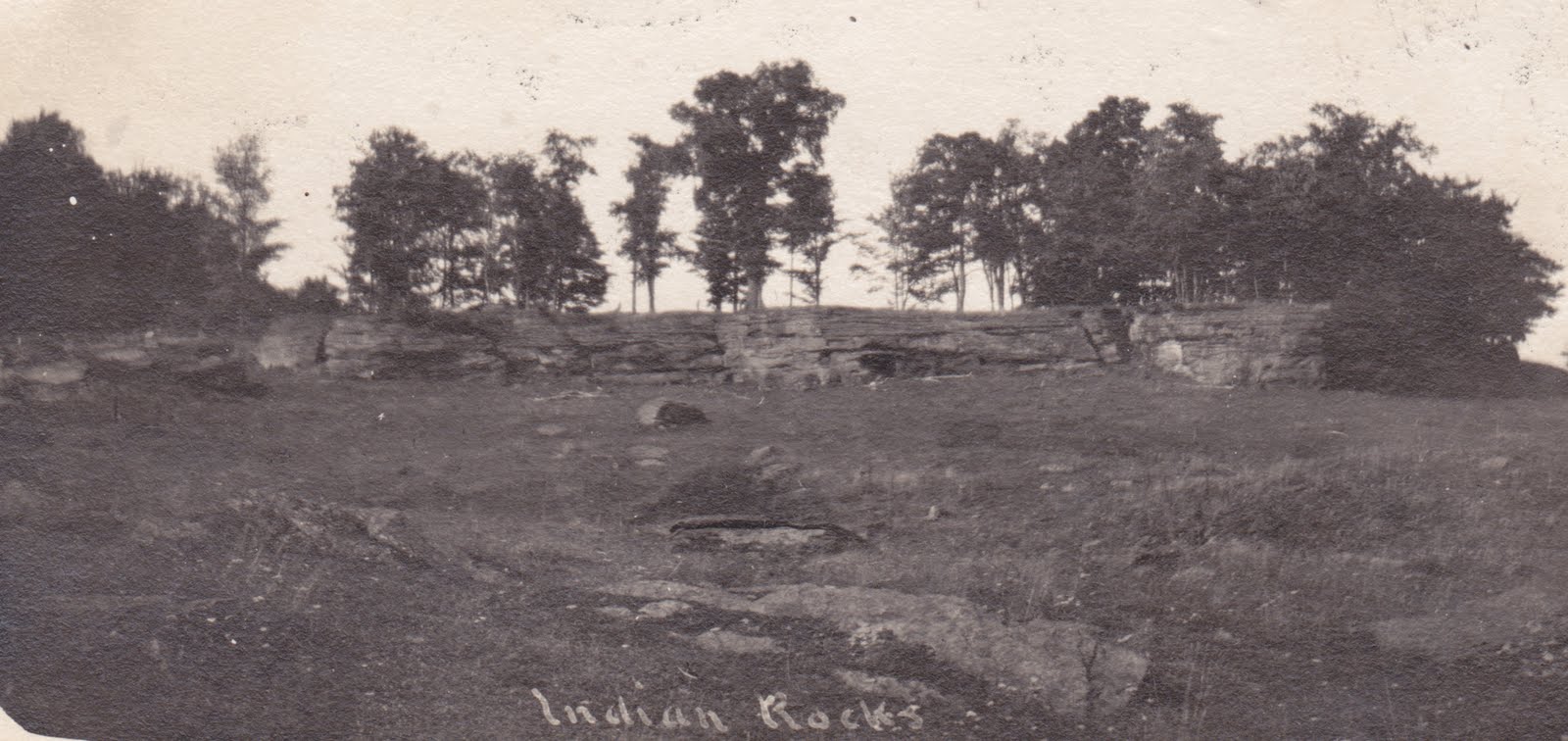
Indian Rocks - a Blast from the Past

Last Sunday (May 22) five intrepid hikers joined me on a May trek to Indian Rocks.  Left to right:  your's truly, Bonnie Denison, Bill DeSilva, Clare Ferguson Lang, Adele Ferguson, Janet DeSilva.  Bill remembered going to Indian Rocks as a kid and had hoped to find where he carved his initials, but we were not successful.  But overall, a very nice hike.

And just this evening, Chuck McIntosh brought me a postcard to scan of what might be the earliest photograph of Indian Rocks.  The postcard dates from 1906, so the photograph is at least that old if not a bit older.  Here it is (click on the image to get the full view):

This picture shows what the right side of the 1906 image looks like today (click on the image to get the full view).  I need to get back up there to try and recreate the full image, but it'll probably have to be in the fall when the leaves are off the trees (this shot was in the spring).  And it may be impossible to recreate the shot because of all the trees. 

Enjoy this blast from the past.  And I'm always looking for other pictures of Indian Rocks. 

Saturday, May 21, 2011

"Bovina Center, My Home Town" - Parts I and II

This is the first of a series of entries from the script used on April 21, 1955, when citizens of Bovina presented a pageant of the town's history - "Bovina Center, My Home Town."  Though I'm not 100% sure, it appears the script was written by Vera Storie and her brother Fletcher Davidson.  The items in brackets refer to the tableau of local citizens acting out parts of the story.

I.  My Home Town - To My Children - Rachel Scott

It is the fall of 1951.  I have spent the greater part of my life in Bovina, in this great farming town with its flowering hillsides and fertile valleys, with its extensive pasture lands and herds of dairy cows ranging over them, and with its small brooks winding merrily along between their low banks, fringed with trees and bushes; and I am anxious that my children and all those that follow in their line may know what manner of people their forefathers were, those early settlers who first chose the countryside in the present town of Bovina as their home, and how from a wilderness they transformed these lands to large productive farms, yielding bumper crops of hay, oats, corns, and other kinds of farm produce.  And so, I have read the pages of history and have studied the old newspapers, and I have interviewed the old timers; and now I shall write, as I find the time, the story of Bovina from the year 1790 to the year 1950.

II.  The First Settlers

In the spring of the year 1790, three or four courageous young men, with their rifles and their knapsacks slung over their shoulders, started out from Westchester County on a surveying and prospecting tour.  Following along Indian trails down to the town of Stamford, at last they invaded the rough, wild, wood countryside, which is today know as Bovina.  [*2 - 3 pioneers with knapsacks during reading]

One of these young men, a liberty-loving patriot who had served his country in the Revolutionary War, looked with favor upon these hills and uplands, a region somewhat similar to the mountainous countryside of Northern England from which his father Isaiah Maynard had emigrated.  He was looking for a home; so he, Elisha B. Maynard, remained and, working industriously for a year, cleared a few acres of land on a part of the farm today known as the Maynard Farm, built a log cabin partly underground, and sowed 1 ½ bushels of rye.  Then he journeyed back to Westchester County for his family; and in the spring of 1792, bringing his household goods on a wood-shod sled, drawn by four oxen, all the way from the Hudson River, he returned and permanently settled on land which was to be known as part of the town of Bovina.

Many were the hardships he and his family had to face in those first years in this wilderness where panthers prowled, where the wily Indians roamed, and where war whoops startled the night.  For many years it was difficult to raise stock here on account of the menace of bears, wolves, and other wild animals, which visited the yards of the log cabins scattered here and there in the clearings in the woods.  However, it was from these animals and from the deer and the fish that the early settlers obtained much of their food.  On rare occasions only did they enjoy the luxury of pork for dinner provided the bears had not captured the pig before butchering time.

In the next year 1793 a son, Elisha H., was born in this family, the first white child to be born in this new settlement.  [*3 - Mother and baby and cradle – with Braham’s Cradle Song]

In the years that followed, this brave couple was blessed with eleven more children, all of whom were given Bibl names, such as Abram, Isaac, Jacob, Ruth, Rachel and Esther.

The first marriage in this primitive settlement, that of James Russell and Nancy Richie, also took place in the year 1793.  [*4-Young bride and husband having picture taken – Song “Melody of Love”]

At the beginning of the 19th century several hardy Scotch, in whose vein flowed some of the gallant blood of the Scotch Highlanders of olden days, crowded into this land on the headwaters of the Little Delaware, they seemed to choose the hilly countryside in preference to the fertile valleys below, partly because of their poverty, the hilly land being cheaper, and partly because of the mountains, which were similar to those they had left in their beloved Scotland.  They were an industrious, intelligent, and religious people, who were devoted to the Presbyterian Church, either United or Reformed.  And so it was that the town of Bovina was settled largely by the Scotch, who brought with them, not only the Scotch Thrift, but also the Scotch love of home, country, and God.