Tuesday, February 12, 2013

Bovina in the Civil War - Soldier Biographies XIV

Daniel, John B., and Robert Tompkins were the nephews of Robert Post of Bovina.  In the 1865 census, they were enumerated with their uncle while in the service, though the Tompkins family was from Roxbury.  The three nephews likely were brothers, the sons of William and Lydia (Post) Tompkins.  Daniel and Robert enlisted the same day, August 19, 1861, Daniel in the 3rd NY Calvalry, Robert in the 20th New York Volunteers.  Robert joined his brother's outfit a year later.  Their younger brother John enlisted in August 1864 as a substitute for Charles E. Loomis.  He was wounded twice - in September 1864 then again in October 1864.  At some point he was absent without leave but he was mustered out in July in New York City.  The information on all three brothers after the war is somewhat confusing.  There is no definitive information for John's life after he mustered out.  It seems that Robert at some point moved to Pennsylvania and in 1915 was admitted to a National Home for Disabled Volunteer Soldiers in Hampton, VA.  Daniel late in life also went to a home for disabled veterans, this one in Ohio.  He died in 1922 and his body was sent to Union Grove, NY for burial.

Robert Tuttle was Bovina's only Civil War veteran to serve in the Navy.  He was born on Cabin Hill in October 1833.  When he entered service in 1863 in the Navy it was as a 1st Assistant Surgeon.  He left service at the end of the war and settled in the Town of Rockland in Sullivan County, working as a physician.  In 1875, he married Emma Bush Parksville.  Dr. Tuttle died in 1910 and is buried in Roscoe.

Charles A. and James Warren were the sons of Horace and Clarissa Warren.  Charles was born in Ulster County in 1835.  He enlisted in August 1862, joining the 144th New York Volunteers as a private.  Discharged after one year because of a disability, he re-enlisted a year later.  During the Battle of Deveaux Neck in South Carolina he was wounded when a bullet struck him under the ear and came out near the eye.  He mustered out with his company in June 1865.  Settling in Fallsburgh, Sullivan County, NY, he died there in 1882.  His brother James, also known as DeWitt Warren, was born in Stamford in 1838.  Enlisting the same time and into the same regiment as his brother, he mustered out with his company on June 1865.  Married to Jane Aitken of Bovina, he lived in Bovina after the war, then moved to Kortright.  He spent the last 25 years of his life in Delhi, where he died in March 1917. 

Friday, February 8, 2013

Another Cathels Family Tragedy

In November 2011, I reported on the tragedy that descended on the family of James Cathels, Jr. in the fall of 1865.  James, four of his children and his mother in law died within about 10 days of each other.  James left behind a pregnant wife and four children. And he and his wife Nancy had lost two other children before 1865.

About a year and a half before this tragedy, the Cathels had another family death in somewhat unusual circumstances - unusual enough to trigger a coroner's inquest.  James father, James Cathels, Sr., was a widower and in February 1864 was living with Peter Dysart.  Dysart had a farm on Russell Hill (the former Lester McPherson farm).  At the age of 72, James Sr. was doing some farm work there, probably to cover his board.

He got up the morning of February 5, 1864 and commented to Peter that his boots pinched his feet.  While using a last to stretch his boots, James inquired of Peter about a caucus meeting held the previous evening in the hamlet.  The exact nature of the caucus meeting is not clear, but given that the town's annual meeting was February 9, this likely was some kind of caucus meeting to nominate candidates for town office.  Whatever it was about, Peter filled him in what had happened.  James then pulled on his boots and headed out to the barn.  Five minutes later, Dysart headed out to feed the animals.  As he started to throw hay down from the hayloft onto the feeding room floor below, he saw Cathels lying there, motionless. Dysart ran around the barn to get in at the lower level and unsuccessfully tried to rouse Cathels.  While he was pretty sure Cathels was dead, he ran over to his neighbor, Stephen Russell, to have him confirm this.   Russell concurred, noting that he could not get a pulse.  They contacted the coroner and sent word to James Jr. at his farm on Scutt Mountain Road about what had happened.

A jury was convened in the Dysart house that same day to examine the body and hear evidence.  The jury included James Douglas, Michael Miller, John Fife (Phyfe), Michael Dixon, Robert F. Scott, Roman Palmer, Robert C. Scott, James Gill, James Thompson, William Lull, Robert H. Sloan, and Richard Smith.  After examining Cathels' body and hearing the testimony of Peter Dysart and Stephen Russell, their verdict was that "James Cathels came to his death by falling on the feeding floor of the cow stable and striking his head on a pole in said stable dislocating one of the upper several vertebrae of the neck causing compression of the spinal morrow which would cause death."

Several of the people connected with this case were, to varying degrees, affected by the U.S. Civil War, completing its third year.   James Cathels, Jr. must have been a little uncomfortable to see James Gill on the jury.  James Jr. had gotten into a brawl with Gill at the Hamilton Hotel in Brushland in October 1862 over a comment Cathels made about Gill's son's Civil War enlistment (see the November 30, 2011 blog entry for more about this incident).  Also on the jury was Roman Palmer, who had only recently moved to Bovina to open a cooperage.  Palmer would enlist later that year and died in battle in December 1864.  Peter Dysart, the owner of the barn where this accident took place, had lost his son Robert in the war the previous October.  William Lull's son Andrew had enlisted in 1862 and would survive the war (as did Gill's son Alexander).  Michael Miller's two brothers, Gilbert and Berry S. Miller, enlisted around the same time as Roman Palmer.  Unlike Palmer, the brothers would survive the war.   

So even while a Civil War was raging, the routines of life - and death - went on back home.  

Thursday, January 31, 2013

Stories from Bovina's Cemeteries - The Müller Family

One hundred years ago this month, on January 15, 1913, Swiss native, Alouisa Martha Marti Müller died at her home in Bovina.  Born in July 1829 in Schmerikon, Switzerland, she was married to Jost Urban Müller in 1854 in the same community.  They appear to have stayed in Schmerikon when they started their family, probably right up to the time they emigrated.

The Müller family came to the United States in the summer of 1870, arriving in New York City.  They did not linger long in the city but headed north to Bovina.  Why they chose Bovina we do not know, but they would stay there the rest of their lives. They purchased a home from Thomas Dennis in 1875.  The house was almost across from where Hugh and Pat Lee live (the house's last owner was Vera Hunter - it was demolished in the late 1990s - see photograph below, taken around 1990).  Urban Müller was a painter, though whether a house painter or an artist is not clear.  At the time of their arrival, the Müllers had four children, Louise, Werner, Emma, and Adolph.  Alouisa would have at least three more children in Bovina, Frederica, Kate and Jennie.  Alouisa and Urban were the parents of fifteen children in all, but eight of them died before Urban's death in 1897.  Likely some, if not all, of the eight died while the family was still in Switzerland.  When Urban died, his fairly brief obituary in the Delaware Republican noted that he was "a genial good citizen."

A decade after her husband’s death, Alouisa lost a ninth child with the death of her son Adolph in Texas.  In the 1910 census, Alouisa and her daughter, Frederica were living in the family house in Bovina, taking in laundry.  Three years later, Mrs. Müller died of pneumonia at the age of 83.  At her death, she was survived by six of her children.  Two of them were out west, Werner in Iowa and Emma (Roper) in Kansas.  Louise was in New York City, where she was a housekeeper in a hotel there.  Three of her daughters lived locally.  Jennie was Mrs. Otis McCumber and living in Andes.  Two other daughters were living with their mother at her death, Frederica and Kate. 

Freda and Kate stayed in Bovina after Alouisa's death.  Their sister Louise joined them about a year later.  Louise had been a housekeeper for many years, starting with Reverend J.B. Lee in Bovina, then later for Judge Murray in Delhi.  After sixteen years working as a housekeeper in two New York City hotels, she developed health problems and had to retire.  Her last years in Bovina were spent mostly bedridden, cared for by her sisters until her death in 1917.  Their brother, Werner Müller moved to Iowa in the 1880s and probably lived in Des Moines up to his death, going by the name of Warner Miller.  He was still alive in the 1940 census, living with his daughter.  His sister Emma Müller was married to Samuel Roper in 1881 and settled in Kansas.  She was widowed before 1920 and still alive in 1940, living with one of her daughters.  Freda and Kate Müller continued to live in Bovina into the 1930s, occasionally going to Andes to help their sister Jennie run her boarding house.  Sometime in the 1940s both sisters moved permanently to Andes, renting out their Bovina house.  They sold it to Bill and Vera Storie in 1944.  Kate died in 1947 and Frederica in 1951.  Their older sister Jennie, the first child born to Urban and Aloisa in America, survived until 1961, dying a few months shy of her 90th birthday.  Urban and Aloisa are buried in Bovina, as are Louise, Kate, and Federica.


Note:  The Mueller family that lived off Route 28 is not related to this Mueller family. There's a great story to tell from this Mueller family that I hope will be a future blog entry.

Monday, January 28, 2013

Thefts in Bovina

A writer for the Delaware Republican in 1888 took advantage of several thefts in Bovina to make a plug for protective tariffs.  Basically, Republicans were for a such a tariff while Democrats saw it as a tax and demanded 'Free Trade.' In the October 20 issue, under the Bovina column was a paragraph about the thefts:

Certain parties in town believe in freed trade and they practice what they preach. Result has been mysterious disappearance of roosters and chickens from several hen roosts, some of our neighbors have been saved the trouble of gathering their apples, while E.C. Dean's flour barrel went down faster than wheat went up in Chicago, and A.D. Thomson was minus a half barrel of pork as a result of this Free Trade. Shot guns have been examined and the next time these Free Traders are found prowling around hen roosts, flour and pork barrels, they will carry home a charge of shot. Protection is the cry in Bovina.

The following week's paper had more on the issue: "... the great question of the hour - the midnight hour - am: 'How am we gwin' to protect our hen roosts.' That is why so many go to the hardware store, to buy powder, shot, padlocks and files - files to sharpen their dog's teeth. 'Shoot 'em on the rise, Edd, steady now.'"

A week later, there was yet another story on the thefts, tied again to the Free Trade issue:

Another hen roost heard from - S.G. Bramley minus twenty chickens, and still our democratic friends cry, 'The Tariff is a Tax.' When, Oh when, will they be convinced that protection is a necessity. Just wait till they wake up some morning and find their democratic rooster has been sacrificed at the altar of "Free Trade," and then they will whoop her up for protection.

It appears that at least some of these thefts were happening around Bramley Mountain.  Edward Carlyle Dean (1854-1926) and Stephen Girard Bramley (1838-1928) both had farms on Bramley Mountain.  Another theft took place at the Pink Street farm of Andrew Dixon (A.D.) Thomson (1845-1890).

Friday, January 18, 2013

Wintertime at Lake Delaware

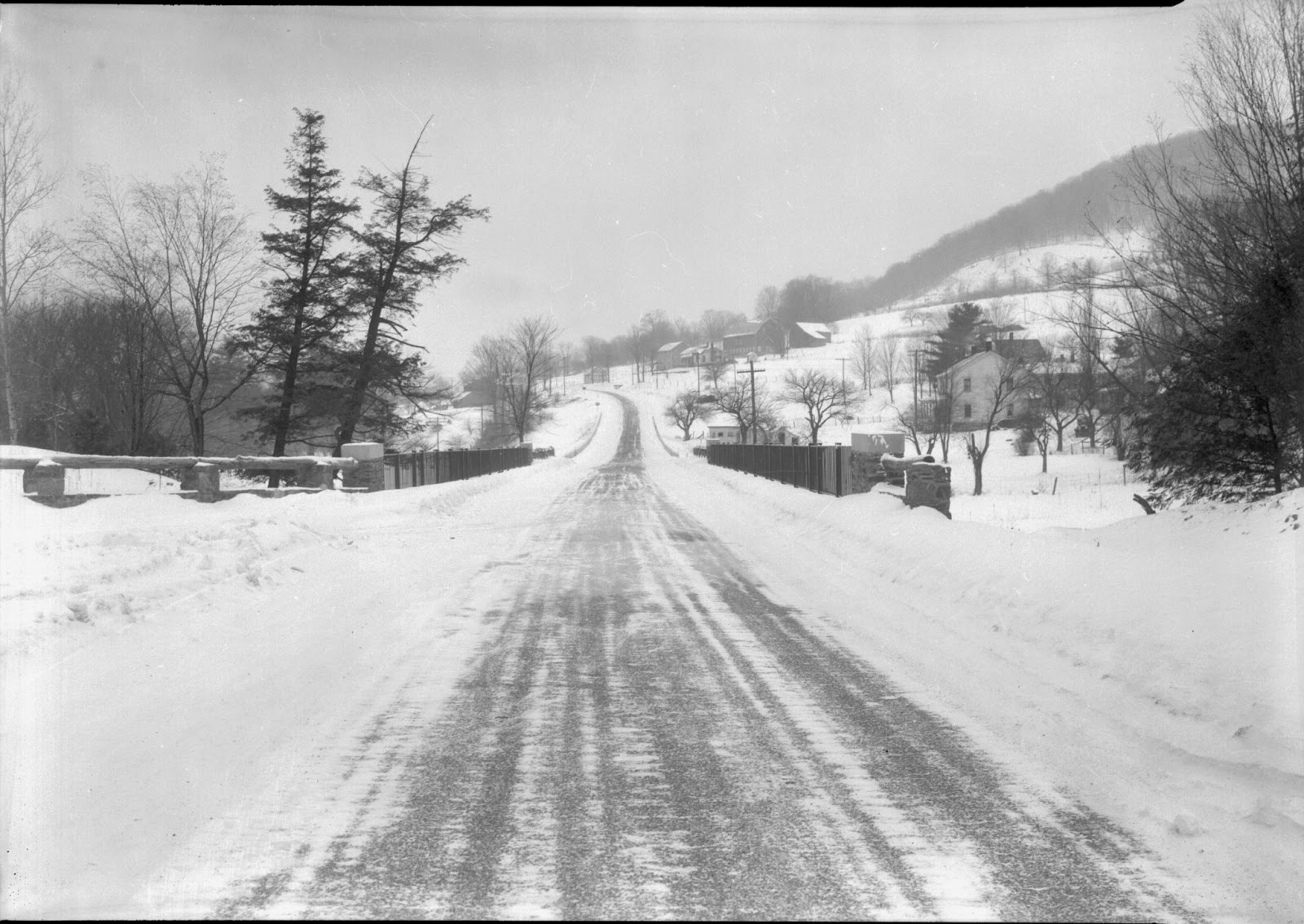
In the interest of sharing Bovina pictures from other than just the hamlet of Bovina Center, I've found three images from the 1930s and 40s of the Lake Delaware area in the winter.  These images come from the Delaware County Historical Association. 

The first two images are from the Association's McMurdy collection and are believed to date form the 1930s.  They were taken from present day Route 28.  The photographer's main objective may have been to photograph the bridge over the Little Delaware, since it shows up in both photos.  You can see in the first photo the St. James Episcopal Church and the rectory.  The bottom photograph shows on the right the area known as "The Hook."  


And below is a Bob Wyer photo, dating from around 1940, showing the Earl Fisk house and barn at The Hook.
Don't forget, I'm always looking for other 'historic' pictures of the Town of Bovina.  I have a scanner and I do travel.  Thanks.

Saturday, January 12, 2013

Bovina in the Civil War - Soldier Biographies XIII

William Storie was born in Delhi, the son of Samuel and Elizabeth Storie.  He enlisted in February 1864 in the 16th Heavy Artillery.  Six months later, William was dead, having died in Point of Rocks, Virginia of disease.  He was buried near where he died.

Samuel Stott was born in Delaware County in October 1845, the son of George Stott.  He enlisted in the 3rd NY Cavalry in February 1864.  Wounded at Stoney Creek, Virginia, Samuel was taken prisoner.  After five months, he was exchanged.  He mustered out at a hospital in Baltimore in June 1865.  Samuel never recovered from his experiences, dying less than five years later in January 1870 of "malignant kidneys," possibly caused by the challenges of being a prisoner of war.

William Stott was the son of Walter and Mary Stott.  Born in March 1842, he enlisted in August 1861 in company F of the 3rd NY Cavalry as a corporal but was demoted to private less than a month later.  William is one of only two Bovina soldiers to be killed in action, dying in the battle of Chala Bridge on May 14, 1864.  His body was not recovered, but there is a memorial stone for him in the Bovina Cemetery. (See the blog entry for April 12, 2011 for more about the family of Walter and Mary Stott.)

William G. Thomson was born in Stamford in October 1842.  At the time of his enlistment in September 1864 in the 144th New York Volunteers, he was six feet tall, with black eyes, auburn hair and a dark complexion.  William mustered out with his company in June 1865 at Hilton Head, SC.  A year after mustering out, William married Frances Frisbee in Delhi.  Settling in Walton, he died there in October 1906.

Monday, January 7, 2013

Our Changing Landscape

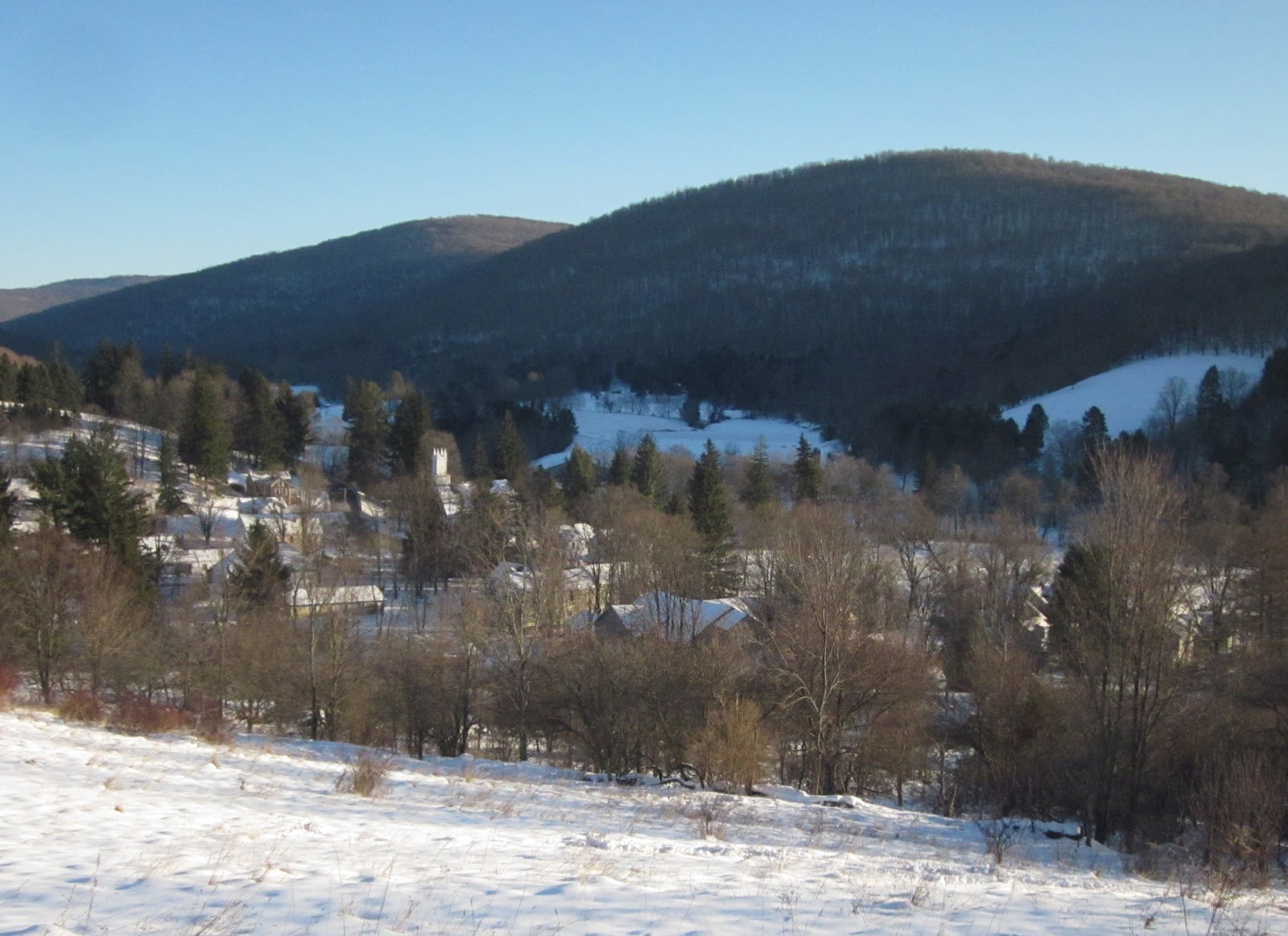
In the late 1930s or early 1940s, Jim Hoy took a series of pictures around Bovina Center.  I decided to try and replicate these photos on January 5 and 7, 2013 - some were easier to replicate than others.  Here are four images I tried to replicate.


This first shot is a general view overlooking the hamlet.  As with all the scenic shots, the big challenge was the growth in vegetation.  One of the biggest changes, beyond the vegetation, is the removal of the Bovina Reformed Presbyterian Church, located where the playground is now located.  The recent shot was taken January 7, 2013.


This one was the hardest, given how much the forest has come back.  I want to try again on the other side of the stone wall.  The smoke is coming from the creamery - this was a common scene and shows up in a number of pictures taken in the 20s and 30s.  The current shot was taken January 5, 2013.


These shots were taken standing in John and Margaret Hilson's driveway, which was Jim Hoy's driveway in the 1940s.  Notice in Jim's picture the third building beyond the firehouse on the left.  That house was demolished in 1960.  The current shot was taken January 5, 2013.


As near as I can tell, Jim was standing in the middle of the street to do this shot, so I did the same. The building on the right closest to the camera was moved back from the road and a bit closer to what is now Mark Foster's house in the 1950s. The current picture was taken January 5, 2013.

Though I'm not sure, I appears the first two shots were not take the same day as the latter two.  Notice how deep the snow is in the bottom two shots.  There is much less snow in the first two.