Showing posts with label Bovina Bicentennial. Show all posts

Monday, November 20, 2023

Bovina Bicentennial Art Project, part 9

As part of the Town of Bovina’s Bicentennial Celebration, Brooke Alderson enlisted a group of ten local artists to create paintings of Bovina Landmarks. The artists were invited to paint their own interpretations of photographs of different Bovina buildings that are no longer in existence or have been altered. The resulting ten paintings were mounted on easels by Brooke and Scott Hill and were displayed throughout the hamlet during the Celebration at the site where the original structure stood (or still stands).

This is the last of the series of entries highlighting the buildings and the paintings. The paintings are on display at the Bovina Public Library, where you can order prints of any that catch your fancy for $80, all proceeds going to the library. And stay tuned for an auction of the original works being planned for this fall.  

Scott’s Bridge, painted by Gary Mayer


At the lower end of the Bovina Center hamlet once stood a picturesque stone bridge spanning the Little Delaware known as Scott’s Bridge. There had been a bridge on the spot since at least 1875, when the first stone arch bridge was built there – and likely there was some other form of a bridge before then.  The town advertised for a contractor in the fall of 1874 to build the bridge by the Scott farm. Contractors were given the option of building “either an Iron, Stone or Wooden Bridge.”  W.R. Seacord and A.B. Phyfe built the first stone bridge on the site, but within three years it was apparent that the foundation had weakened and that repairs were needed. Supports were placed under the bridge to support the keystone, but while the workmen were away one day, the arch collapsed. The replacement stone arch bridge was built by William Cooke and George Currie. That bridge lasted almost 80 years.

The bridge was part of what became known as the S curve at the lower end of town. During the era of horse drawn vehicles, the need to turn left to cross the bridge and right as soon as the crossing was accomplished was not a big deal, though it still took some skill. The change from horse drawn vehicles to trucks and automobiles made the bridge much more challenging to maneuver - it was easy to scrape your car on the sides of the bridge. It became the site of several accidents, though none with any fatalities, as far as can be determined. In 1924, four lumbermen working for the Johnston mill had an accident when “frost on the windshield of their car kept them from seeing the turn of the bridge. Striking one side they slide to the other and then landed in the overturned car at the roadside.”

Modern vehicles were proving to be too much for the bridge. Discussions began in the 1930s about replacing the bridge. The Stamford Mirror-Recorder in 1934 reported on “Bad Bridge At Bovina Center.” The article noted that the bridge “is a battle-scarred old landmark and there is plenty of evidence to show that not all motorists have crossed it without touching some place.” The newspaper went on to report on an accident about three years earlier: “This man had come over the hill into Bovina Center…and he had a rude awakening. He knocked a huge chunk out of the 12-inch concrete guard rail and sustained a broken leg.” His passenger also was injured. The paper noted that litigation followed. “The many accidents there have brought about surveys for a new structure, but that is as far as the action has gone.”

Discussions and debate continued into the 1940s and 1950s. The bridge was closed in the winter of 1951 for repairs, causing “great inconvenience as the detour by Lee Hollow is very much out of the way to Bovina.” Action on replacing the bridge likely was spurred by a flash flood in August 1953. Several trees were caught in the bridge. 

A few months after the flood, in March 1954, the Bovina Town Board passed a resolution requesting that a new bridge be built:

"Resolved: Whereas the bridge at Bovina Center has been deemed unsafe for travel,

"Whereas, two school buses, one carrying 52 children and the other 25 children, are forced to unload the children and said children must walk across said bridge on their way to school in the morning and on their return at night,

"Whereas, this is the main outlet of said Town – all milk being hauled in trucks from community and all grain and supplies hauled in comes over this bridge,

"Whereas, the Post Office at Bovina Center is reached by a mail car using this bridge,

"Whereas, the bridge in use was built in the 1870's and very little repair work has been done since then,

"Whereas, signs stating, “Proceed at your own risk” has been posted at the approaches to the bridge,

"We, the undersigned members of the Town Board of the Town of Bovina, do recommend that a new bridge be built as soon as possible." 

Construction started on the replacement bridge in September 1954. It was built a bit downstream from the old bridge, allowing the old one to continue in use during construction. 

The replacement for Scott’s bridge was opened to traffic in early July 1955. Two other bridges were built in Bovina at the same time.  The bridge that crosses Brush’s Brook, next to what was the Thomas Garage was replaced and opened in the late fall of 1954.  A third bridge was built to replace one that crossed Coulter Brook on Coulter Brook road.  This spate of bridge building was spurred, in part, by the August 1953 flash flood that damaged these bridges. 

Much to the disappointment of many, including Stella McPherson, who lived across the street on what had been the Scott farm, the old stone arch bridge was demolished on July 26, 1955. For a bridge said to be weak, it was pretty stubborn about coming down and took all day to demolish. Sadly, given that I was three-months old at the time, I do not remember the old stone bridge, though there are many in Bovina who still do. We are lucky that we have several photographs of Scott’s Bridge so we all can remember it.


Gary Mayer is from Detroit, Michigan. He studied art at Wayne State University in Detroit and became influenced by a group of artists called the Cass Corridor School, named after the area where they lived and worked.  Gary moved to NYC in 1982. During that time, he had numerous solo and group shows. In 2004, after spending over 20 years in NYC and Brooklyn, Gary moved to the Catskills. In the last decade he has shown his work widely in the area and helped form the GreenKill art space in Kingston. He is currently a member of the Longyear Gallery in Margaretville, NY.   “My work has always fluctuated between abstraction and figuration.  I find that one feeds and sharpens the other and they both share an intensity and painterliness.”


Friday, October 20, 2023

Bovina Bicentennial Art Project, part 8


As part of the Town of Bovina’s Bicentennial Celebration, Brooke Alderson enlisted a group of ten local artists to create paintings of Bovina Landmarks. The artists were invited to paint their own interpretations of photographs of different Bovina buildings that are no longer in existence or have been altered. The resulting ten paintings were mounted on easels by Brooke and Scott Hill and were displayed throughout the hamlet during the Celebration at the site where the original structure stood (or still stands).

Over the next few months, I will be doing a series of entries highlighting the buildings and the paintings. The paintings are on display at the Bovina Public Library, where you can order prints of any that catch your fancy for $80, all proceeds going to the library. And stay tuned for an auction of the original works being planned for this fall. 

Kinmouth Store painted by Tim Cunningham


This house possibly was built by John Kinmouth, who was a carpenter from Perthshire, Scotland. John came to the US around 1836. His brother, Alexander, who probably helped his brother to build the house, lived in it for many years, running a grocery store from it. He likely died in the house in 1882.  

The home was later owned by George Miller – he made some changes to the veranda. The house later came to George’s grandson, Clark Lay. Clark and Gladys lived in the home for many years. The house has had several owners since Clark and Gladys’ time, including Tim Cunningham, the artist of this painting. 


Timothy Ashton Cunningham    Born and raised on the south shore of Long Island. A lifelong waterman, sportsman, operating room nurse and artist. I work with acrylics, watercolor and line drawings. I also use my creative energy in woodworking and clay. 1669 Main Street, Circa 1850 has a history of being a cooperage and a general store as well as my first residence in Bovina. It was also my subject for this project. Bovina became our full-time residence when we purchased the abandoned Ganger Farm on Cape Horn Road in 2012. The farmhouse has become our passion and with the help of local artisans we have lovingly restored the building. We have named it the Sleeping Grouse Farm. My latest art project is a series of Tuscan and Sicilian market scenes. They are the product of our Italian adventures in a fiat 500. 


Wednesday, September 20, 2023

Bovina Bicentennial Art Project, part 7


As part of the Town of Bovina’s Bicentennial Celebration, Brooke Alderson enlisted a group of ten local artists to create paintings of Bovina Landmarks. The artists were invited to paint their own interpretations of photographs of different Bovina buildings that are no longer in existence or have been altered. The resulting ten paintings were mounted on easels by Brooke and Scott Hill and were displayed throughout the hamlet during the Celebration at the site where the original structure stood (or still stands).

Over the next few months, I will be doing a series of entries highlighting the buildings and the paintings. The paintings are on display at the Bovina Public Library, where you can order prints of any that catch your fancy for $80, all proceeds going to the library. And stay tuned for an auction of the original works being planned for this fall. 

Hilson’s Store, painted by Mike Casey 


On August 15, 1867, Andrew T. Strangeway recorded in his diary "Very rainy today…we went to Brushland to the Raisin[g] of John Hilsons Store.”

Hilson’s Store stayed in the family through multiple generations. The original Hilson, John Hilson, sometimes referred to “Old Jock” in later life, came to America from the Scottish borders region in 1850 when he was 23 years old. He opened his store in 1867. The store passed to his son Alexander in 1889. Alexander ran the store until 1915, serving for much of that time also as the Bovina Center postmaster. When he retired, he turned it over to his sons John and James Hilson. The firm became Hilson Brothers. The brothers ran the store into the 1950s. John’s sons, Alex and Jack, took over the store, with some help from their Uncle Jim. 

Gas lights were installed in the store in 1900. A new ceiling and new counters were installed in 1906. The Hilson Brothers in 1920 installed a Delco Lighting plant to light the store and the residences of John Hilson and his father Alexander. In 1928, further changes were made to the store, including digging a cellar underneath to install a furnace.  

The grocery store closed in the 1970s. The brothers continued to operate it as a hardware store into the 1980s but found that as the number of farmers declined so did demand from anything in the store. So, in 1986 the store was closed, and the contents auctioned off. The store is slated to become the Dry Town Tavern.


Michael Frank Casey

b.1952  Pearl City, HI  (.75 hrs after Patrick Charles Casey)

1973 BFA –  Museum Art School   Portland, OR

1974 Co-Founder -  Purple Daggers Gallery   Portland, OR

1979 Married  - Susan Anne Yelavich

1984 Son Born  - Henry Theodore Casey

1987 Home Purchased  - 1784 Main Street, Bovina Center, NY


Sunday, August 20, 2023

Bovina Bicentennial Art Project, part 6


As part of the Town of Bovina’s Bicentennial Celebration, Brooke Alderson enlisted a group of ten local artists to create paintings of Bovina Landmarks. The artists were invited to paint their own interpretations of photographs of different Bovina buildings that are no longer in existence or have been altered. The resulting ten paintings were mounted on easels by Brooke and Scott Hill and were displayed throughout the hamlet during the Celebration at the site where the original structure stood (or still stands).

Over the next few months, I will be doing a series of entries highlighting the buildings and the paintings. The paintings are on display at the Bovina Public Library, where you can order prints of any that catch your fancy for $80, all proceeds going to the library. And stay tuned for an auction of the original works being planned for this fall. 

J.R. Douglass home, painted by Cornell Verlaan


James R. Douglas had a farm on this property since about the 1840s. He died in 1873. It became the home of Alexander Hilson in 1887, having purchased it from David “Champ” Worden. In 1924, Alex’s widow, Isabella, decided to replace the house. The old house was moved to one side in April 1924 and she continued to live in the house while the new house was constructed. She was able to move into the new house in November. The old house was demolished by Fletcher Davidson in early 1925. He used some of the wood to build a chicken house behind his house. 


Cornelis Verlaan   Born in the Netherlands, 1947.  Free Academy of Arts, the Hague; The Ateliers, Haarlem; Indiana University (MFA); Seifert Verlaan Inc, Fine Art Shipping, NYC, 1979-2018; Solo exhibitions in the Netherlands and US since 2003,  including three traveling photo shows on  Delaware County;  Area group exhibitions and Longyear Gallery;  Bovina resident  since 1985. 


Tuesday, June 20, 2023

Bovina Bicentennial Art Project, part 4


As part of the Town of Bovina’s Bicentennial Celebration, Brooke Alderson enlisted a group of ten local artists to create paintings of Bovina Landmarks. The artists were invited to paint their own interpretations of photographs of different Bovina buildings that are no longer in existence or have been altered. The resulting ten paintings were mounted on easels by Brooke and Scott Hill and were displayed throughout the hamlet during the Celebration at the site where the original structure stood (or still stands).


Over the next few months, I will be doing a series of entries highlighting the buildings and the paintings. The paintings are on display at the Bovina Public Library, where you can order prints of any that catch your fancy for $80, all proceeds going to the library. And stay tuned for an auction of the original works being planned for this fall. 

Boyd Place, painted by Lizbeth Firmin


It is not clear when this house was built, but likely in the 1840s or 1850s. It was owned by James Gill and later by William Gladstone. For many years, it was owned by the Boyd family, starting with Andrew and Ellen Boyd. Ellen lived in the house after the death of her husband in 1879. After Ellen’s death in 1893, the house was rented out. In the 1890s at one point, a gentleman named Samuel Ingles ran a barber shop there. The house was sold in 1913 by Ellen’s grandson, Andrew J. Boyd, to newlyweds John and Helena Hilson. They started the process to build a new home behind the Boyd house, intending to demolish it. They had barely moved out of the house into rooms nearby and arranged for the house’s demolition, when on June 6, 1916, the house burned down. The local hook and ladder company were meeting not far away and got to the fire quickly but focused mainly on ensuring adjoining properties did not suffer the same fate. By January 1917, John and Helena were living in their new home. 


Lisbeth Firmin is a contemporary American realist known for her urban landscapes. For over five decades her work has been in hundreds of solo and group show across the country and internationally. Honors and awards include inclusion in” “New Prints 2018/Winter, IPCNY, “2017 North American Print Biennial”, 2017  solo exhibition at University of North Carolina, Chapel Hill, a 2017 Printmaking Residency @ Scuola Internazionale di Grafica, Venice, Italy, Printmaking Residency  @ Tides Institute in Eastport ME (2016), a NYFA Fellowship (2007), Pollock-Krasner Grant (1999), full fellowships to the MacDowell Colony, National Seashore Residency, the Vermont Studio Center and Saltonstall Arts Colony. Her paintings and prints are in several public collections including the New York Historical Society, Provincetown Art Association & Museum, Munson Williams Procter Arts Institute, Arnot Museum, Tides Institute and Museum of Art, Fleming Museum, University of Texas, Cape Cod Museum, and Hofstra University. Firmin moved from downtown NYC in 2000 to a small village in upstate NY, where she paints every day.

Saturday, May 20, 2023

Bovina Bicentennial Art Project, part 3


As part of the Town of Bovina’s Bicentennial Celebration, Brooke Alderson enlisted a group of ten local artists to create paintings of Bovina Landmarks. The artists were invited to paint their own interpretations of photographs of different Bovina buildings that are no longer in existence or have been altered. The resulting ten paintings were mounted on easels by Brooke and Scott Hill and were displayed throughout the hamlet during the Celebration at the site where the original structure stood (or still stands).


Over the next few months, I will be doing a series of entries highlighting the buildings and the paintings. The paintings are on display at the Bovina Public Library, where you can order prints of any that catch your fancy for $80, all proceeds going to the library. And stay tuned for an auction of the original works being planned for this fall. 


Bovina Methodist Church, painted by Rick Mills 


Methodism in Bovina was of long standing, though for many years, there was no organized congregation. They met in any available dwellings, schoolhouses or even barns. The main name in Bovina Methodism in its early years was Alexander Brush, Bovina’s early settler. For years services were held in his house where he preached the service. 


Methodists were not popular in Bovina in the town’s early years. They once found the school house locked against them, though a vote did finally allow them to use it. In 1848, the Methodists resolved to build a church on land given to them by Alexander Brush for that purpose. The building was completed in 1849 at a cost of $1,397.50. The dedication took place August 22nd, 1849, though not without incident. The pastor of the Bovina Associate Presbyterian Church, Reverend John Graham, received an invitation to attend the dedication and consecration of the new Methodist church. In his pulpit, Graham strongly condemned this stating “the consecrating of churches, grave-yards and other things was heathenish and popish…” 


Until April 1871, the Andes and Bovina Methodist congregations comprised had one pastor. They were divided that year, each with its own pastor. In 1865, membership was at fifty, by 1875 it was sixty-three, with usual attendance of about 100. A parsonage was purchased for $2,000 in 1871 and in 1877 the church was repaired and renovated on the inside, with a capacity to seat three hundred.


As the new century dawned, however, the membership numbers for the Bovina Methodist church fell and in 1916, the church began sharing its pastor with the Andes congregation again. The last trustees of the church, John Blair, Charles Hafele and David C. Worden, sold the church building and parsonage in November 1921. The church building property was sold to William Archibald for $775. The local paper reported “it is a number of years since Bovina Center has had a resident Methodist pastor to occupy the parsonage, and the congregation has become so small that services have not been held regularly and it has become a burden on the small membership to maintain a church organization.”  The parsonage next door was sold at the same time. 


Archibald announced plans to tear down the church, hiring David Worden to dismantle the church.  The church did not come down for a few years. Life-long Bovina resident Jack Hilson remembered roller-skating in the church building and Celia Coulter recalls her sister Ruth having played basketball there. The church was torn down in April of 1926.  Worden used the timbers to build a barn on his farm on Reinertsen Hill Road. That building no longer exists. Archibald then built his home, which still stands today. In 1930, the Bovina Community Hall was built across the street from the Archibald home. 


The Artist

Richard Kirk Mills  - I have at various times narrated, interpreted, represented, (re)designed and abstracted the landscape. After fourteen years of collaborative public eco-artwork I built a house in Bovina and returned to painting, working from the everyday, familiar places around me, seeking to create images that are at once subtle and iconic. I hope that the years of revealing the often hidden cultural and environmental history of place informs my recent work; reflecting a deeper feeling for layers of landscape and memory. Ultimately, I am trying to make good paintings from my experience.


I earned an MFA from City College, drove a taxi, worked as a master printer, taught at the Pratt Graphics Center and was professor of art at Long Island University for 28 years.

More work can be seen at: https://richardkirkmills.net/home.html  and at Longyear Gallery in Margaretville and in NYC at Blue Mountain Gallery.


Thursday, April 20, 2023

Bovina Bicentennial Art Project, part 2


As part of the Town of Bovina’s Bicentennial Celebration, Brooke Alderson enlisted a group of ten local artists to create paintings of Bovina Landmarks. The artists were invited to paint their own interpretations of photographs of different Bovina buildings that are no longer in existence or have been altered. The resulting ten paintings were mounted on easels by Brooke and Scott Hill and were displayed throughout the hamlet during the Celebration at the site where the original structure stood (or still stands).


Over the next few months, I will be doing a series of entries highlighting the buildings and the paintings. The paintings are on display at the Bovina Public Library, where you can order prints of any that catch your fancy for $80, all proceeds going to the library. And stay tuned for an auction of the original works being planned for this fall. 


Kennedy Hotel, painted by Sandra Finkenberg


The History


It is not clear when this house was built but it was owned by Rev. Joshua Kennedy, pastor of the Bovina Reformed Presbyterian Church in the late 1860s. It was used as a boarding house for many years. George Gladstone owned from 1904 until 1919 when it was bought by John Aitkens in the 1920s. 

The building in 1947, when it became the Center Inn.

From the May 16, 1947 Walton Reporter


In May 1947, Edward Burton Cornell and his wife Ethel opened a restaurant and bar in the building, calling it the Center Inn. The Cornells were experienced restauranteurs. People were attracted to the inn not only by the bar but by the food. 

But the bar became an issue almost immediately, spurring an effort by citizens in the town to vote for Bovina to become a dry town. The Center Inn caused problems with traffic in the hamlet. And some families simply didn’t like having it there, seeing it as a distraction for husbands and fathers. When Delhi debated whether to stay dry in the 1940s, the example of Bovina’s situation was brought up. “A prominent Bovina man told me that the residents of Bovina Center are thoroughly ‘fed up’ with conditions created by the recent advent of the saloon there… Pleasure cars, trucks and old jalopies bring customers to the Bovina bar, filling the limited parking space nearby, causing traffic congestion and confusion; children are seen going in and out of the place, and the noise continues until late at night.” 

The local option to go dry passed in November 1947 by a two to one margin. Cornell had until about the fall of 1948 before he had to stop the sale of alcohol. He sold the contents in October of that year. The building became derelict and was demolished in December 1960.

Photo by George LaFever, December 1960


More about this vote in 1947 may be found at this blog at: Bovina (NY) History: Bovina, Wet or Dry? - Part II (bovinanyhistory.blogspot.com)


The Artist

Sandra Finkenberg studied at the Carnegie Mellon School of Art in Pittsburgh and the Art Students League in New York. She has received numerous awards including 2nd place at the Catherine Lorillard Wolfe Art Club (2003), Best of Show Cooperstown Regional(1997), and Best of Show and 2nd Place, UCCA  Oneonta (now CANO) (1993 and 1992 respectively). 

“My thoughts in painting The Kennedy Hotel: Nothing is permanent but what sticks in memory. My youth was marked by many changes spanning the country. By selling my art and living in Manhattan with my husband and 6 children we managed to stake out the old Chase farm in Bovina. Though I had no history in this Delaware County, its simple style evokes the lives of both grandparents who were rooted in Chemung and Cayuga Counties. Sometimes I find myself checking for accuracy with those soft old memories passed away yet mysteriously passed down.”


Monday, March 20, 2023

Bovina Bicentennial Art Project, part 1


As part of the Town of Bovina’s Bicentennial Celebration, Brooke Alderson enlisted a group of ten local artists to create paintings of Bovina Landmarks. The artists were invited to paint their own interpretations of photographs of different Bovina buildings that are no longer in existence or have been altered. The resulting ten paintings were mounted on easels by Brooke and Scott Hill and were displayed throughout the hamlet during the Celebration at the site where the original structure stood (or still stands).


Over the next few months, I will be doing a series of entries highlighting the buildings and the paintings. The paintings are on display at the Bovina Public Library, where you can order prints of any that catch your fancy for $80, all proceeds going to the library. And stay tuned for an auction of the original works being planned for this fall. 


The Library thanks all the artists: Michael Frank Casey, Timothy Ashton Cunningham, Sandra Finkenberg, Lizbeth Fermin, Lori Glavin, Scott Hill, Gary Mayer, Richard Kirk Mills, Antonio Mora, and Cornelis Verlaan for allowing their wonderful paintings to be displayed at the Library, and reproduced both in this booklet and as individual full size prints. Special thanks also goes to Torkil Stavdal for photographing the paintings.


The entries will be presented in geographic order, with one building featured each month through November. 


Strangeway’s Store, painted by Antonia Mora


History


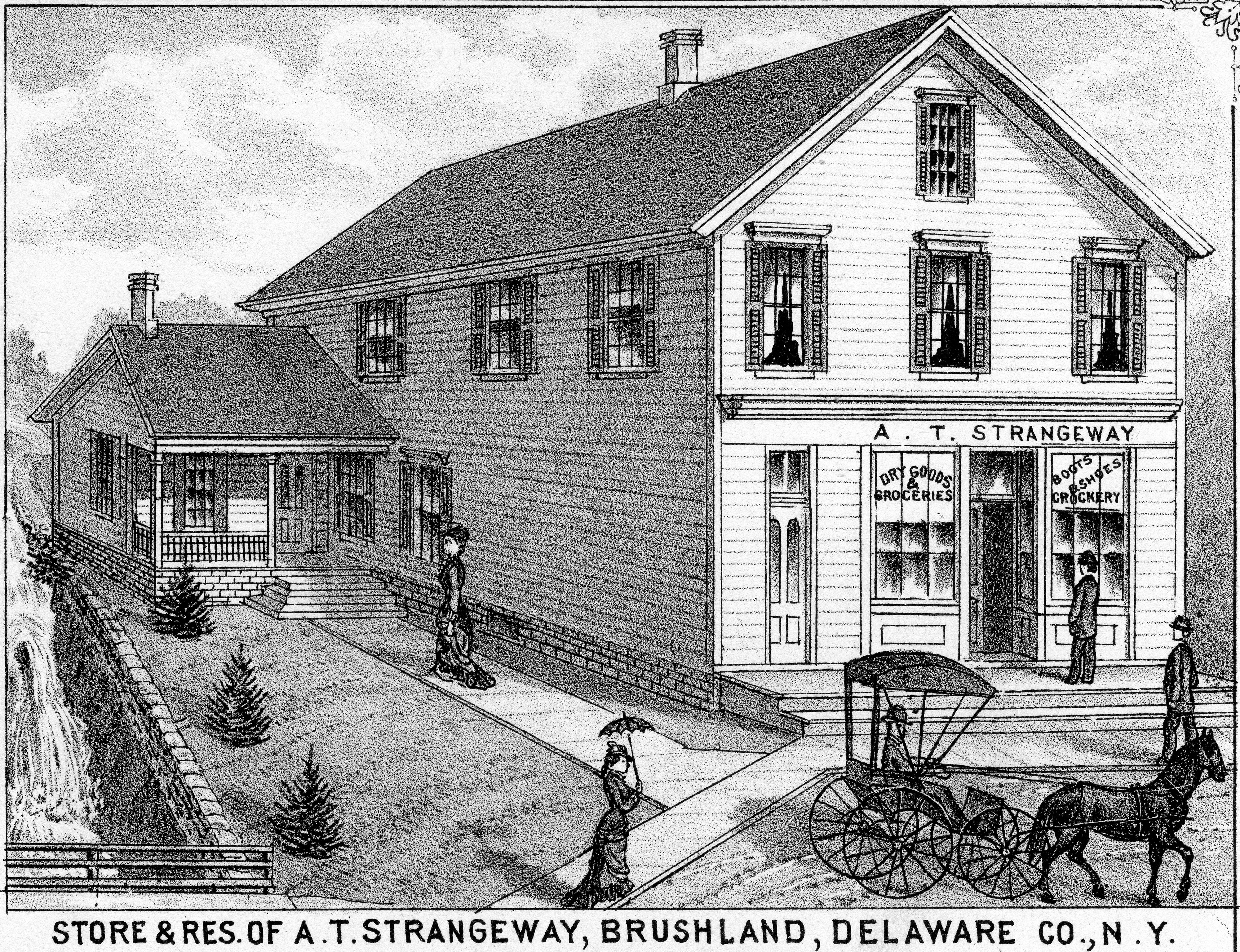
A store has stood on the site of what later became Strangeway’s since at least the 1850s. In the 1860s, it was owned by James Elliott and included the post office. On April 10, 1872, the building burned down. There was insurance of about $500 on the building and $2,000 on the goods. Andrew Strangeway reported in his diary that the store “was consumed to ashes in about 1 hour.”


A couple of weeks later, the April 24, 1872 Delaware Gazette called into question how the fire started: "We learn that Mr. Elliott, of Bovina, whose store and goods were consumed by fire on the night of the 9th inst., was in embarrassed circumstances, and has since absconded; and it has come to light that he has been using the names of some friends rather freely. Forgeries to the amount of $3,000 have been discovered. Alexander Kinmonth and Andrew Gladstone are the principal victims. It is now quite clear how the store came to burn. Mr. Elliott is a former Supervisor of Bovina." Interestingly, Alexander Kinmouth was James’ father-in-law. Elliott left the area permanently, settling in Chicago, where he died in 1896.

From Munsell's 1880 History of Delaware County


Undated image from late 19th/early 20th century


A new store was built in 1874 by Andrew T. Strangeway. Born in Bovina in 1839, Strangeway was a businessman early in his adult life. In the 1860s, he was selling Thayers Iron Mower to farmers as the agent for Delaware County. For several years, he partnered with John Hilson in operating what later was Hilson’s store. They dissolved the partnership in 1872 and two years later Strangeway built his store. 


The store was barely open when it was burgled, with “about $30 in money and $50 worth of goods, consisting of gloves, boots and shoes, etc taken.” Strangeway had interests in selling a wide range of products over the years. He sold something called “Bradley’s Superphosphate of Lime.” The ad in the Delaware Gazette in May 1875 noted that it was “A Powerful Manure.” As communication technology progress, Strangeway’s store became the home for the telegraph office in Bovina Center and, in 1895, it became the telephone office. 


In another business venture, Strangeway built onto the back of his store a hall in 1888. One of his competitors, John Hastings, who had what is now Russell’s Store, built a hall at the same time (though not attached to his store but somewhere behind it). The October 4, 1888 Hobart Independent reported this, noting that “Opposition is the life of business.” Strangeway’s Hall was used for annual town meetings and other public events until the Bovina Community Hall was built in 1930. 


Andrew operated the store until his death. In May 1907, he went to Rome, NY to have a growth on his lip removed, but the Andes Recorder noted that he also had heart issues. Though the procedure to remove the growth was successful it put too much of a strain on his body and he died only a few days after returning home. Several auctions took place over the next year to liquidate the store contents. 

This postcard probably dates from the 1910s.

Clayt Thomas' garage in August 1953 after the flood that hit the town. Photo by Bob Wyer.


The store had several owners after Strangeway’s death in 1907, including at one point his two competitors – John Hilson and A.T. Doig.  The building was sold to Arthur Hillis in late 1923 and was converted into a garage. He sold the business to Kenneth Kaufman in 1927. Clayton Thomas bought the garage business in 1936 and ran it until his retirement in 1970. Wayne Gallant had the garage for a decade, starting in 1974. Heinz Berneke ran Bovina Motor Works from the garage for several years.  Current owner Tom Hetterich has put a lot of work into renovating the building, including Strangeway’s Hall.  


The Artist


After studying fine art at the Fashion Institute of Technology in New York, Antonio Mora amassed over twenty-five years’ experience in restaurant kitchens including such well known eateries as Restaurant Daniel in New York and Avenue in Long Branch, New Jersey, earning a two star review from the New York Times and a rave from Gourmet. His education in color relationships, form, line, perspective and theory has given him a solid base on which to build his skills as a cook and chef, and his food is as balanced and beautiful as it is delicious.

In the wake of the disruptive global pandemic, Mora left the city and worked with Sohail Zandi at Brushland Eating House and Russell’s General Store in the western Catskill Mountains of New York. He remains active as an illustrator, creating commercial labels and fine art prints.


Tuesday, January 31, 2023

Remembering the Bovina Bicentennial Parade, Part 4


For the month of January, I’m going to do daily postings on the Town of Bovina Historian Facebook page on the Bovina Bicentennial parade held on July 30, 2022. This is the last of four postings in January sharing these entries with you. I thought it would be nice during the cold winter months to reminisce about that lovely day in July. It’ll also serve a second purpose – I may have missed some names and other information on the parade entries, so please contact me at bovinahistorian@gmail.com. I want to have an accurate record of the parade.

• January 24, 2023 - The Kortright Kritters 4-H Club from Bloomville: Jackie Gray; Jason, Addyson and Hayden Olsen; Traci and Emma Mason; Sami, Dennis, James and Elaina Deysenroth; Elisa, Gabi and Brayden Barnhart; Marisa Jasper; Justice Dibble; Indea, Jeff, Phoebe and Gideon Knapp; Makenna Wright and Natalie Brunner.


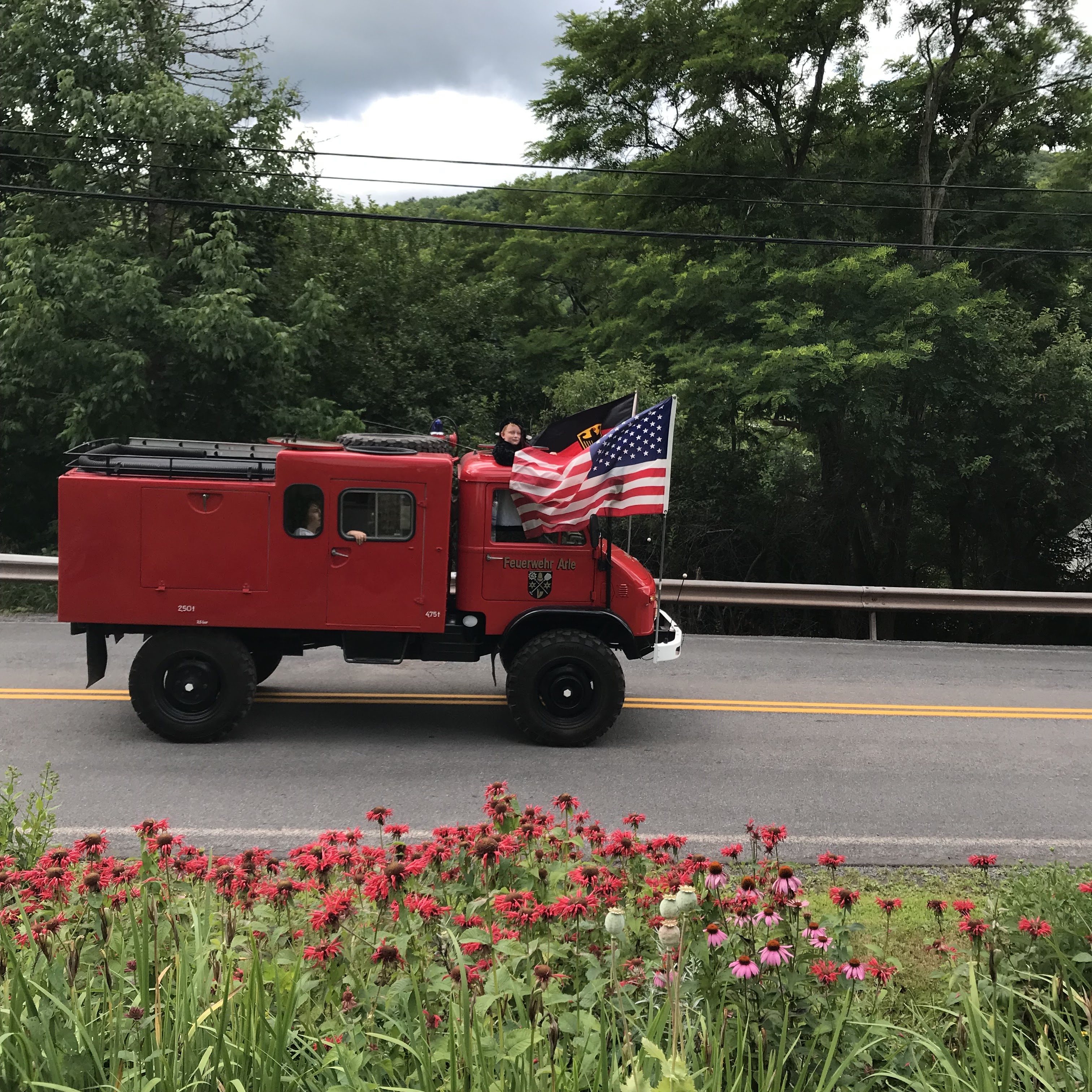
• January 25, 2023 - A.J. Foster drove his 1961 Mercedes Unimog 404 fire truck, with on-board water tank, PTO pump, and hoses. Traveling with him were Asher and Finn Manning.


• January 26, 2023 - The parade saw a number of horses. Delaware County Sheriff Craig Dumond, rode in the parade with 90 year old Roxbury Constable Steve Williamson. 87 year old Bovina native Marge Rockefeller rode, along with her niece, Donna Weber, and her friends Rachael and Sarah Fisher. A group also came from Broken Spoke Stables in Hobart: Kelsey Cole, Christy Cole and Lilly and Harley Murdie.


• January 27, 2023 Bovina United Presbyterian Church – Marie Tucker, Pastor Ernie Varga, Colton Schneider. Richard Tucker driving the truck. Marie Tucker noted on the church's Facebook page: "They say it takes a village to raise a child - it also takes a village to put together a lovely float. John Hilson renovated the church - Colleen Heavey painted it. Margaret Hilson put in HOURS painting the stained glass windows. Tim and Kristin Janke Schneider helped Richard Tucker put the church on the trailer.  Richard assembled all the framework for the railing and banner. Kayla Ann and her daughter, Natalie came to my house on Friday to help me put the final cosmetic touches on!! It was a very fun day!!"

The model of the UP Church appeared in a parade in Bovina in 1956.


• January 28, 2023 - Bovina Public Library, with Librarian Annette Corvelo in truck, driven by Michael Breidenbach.


• January 29, 2023 - LaFever Excavating celebrating the Bicentennial and its 75th anniversary, with Jonathan LaFever (driving), Susan LaFever, Karlie LaFever and Bodie Craver.


• January 30, 2023 - The Lake Delaware Boys Camp came out in force for the parade, with about 120 campers marching and playing drums and bugles. They provided a wonderful conclusion to the parade - and a drill demonstration right after.


Derek Smith got this shot from his truck of the Boys Camp getting ready to do their drill.


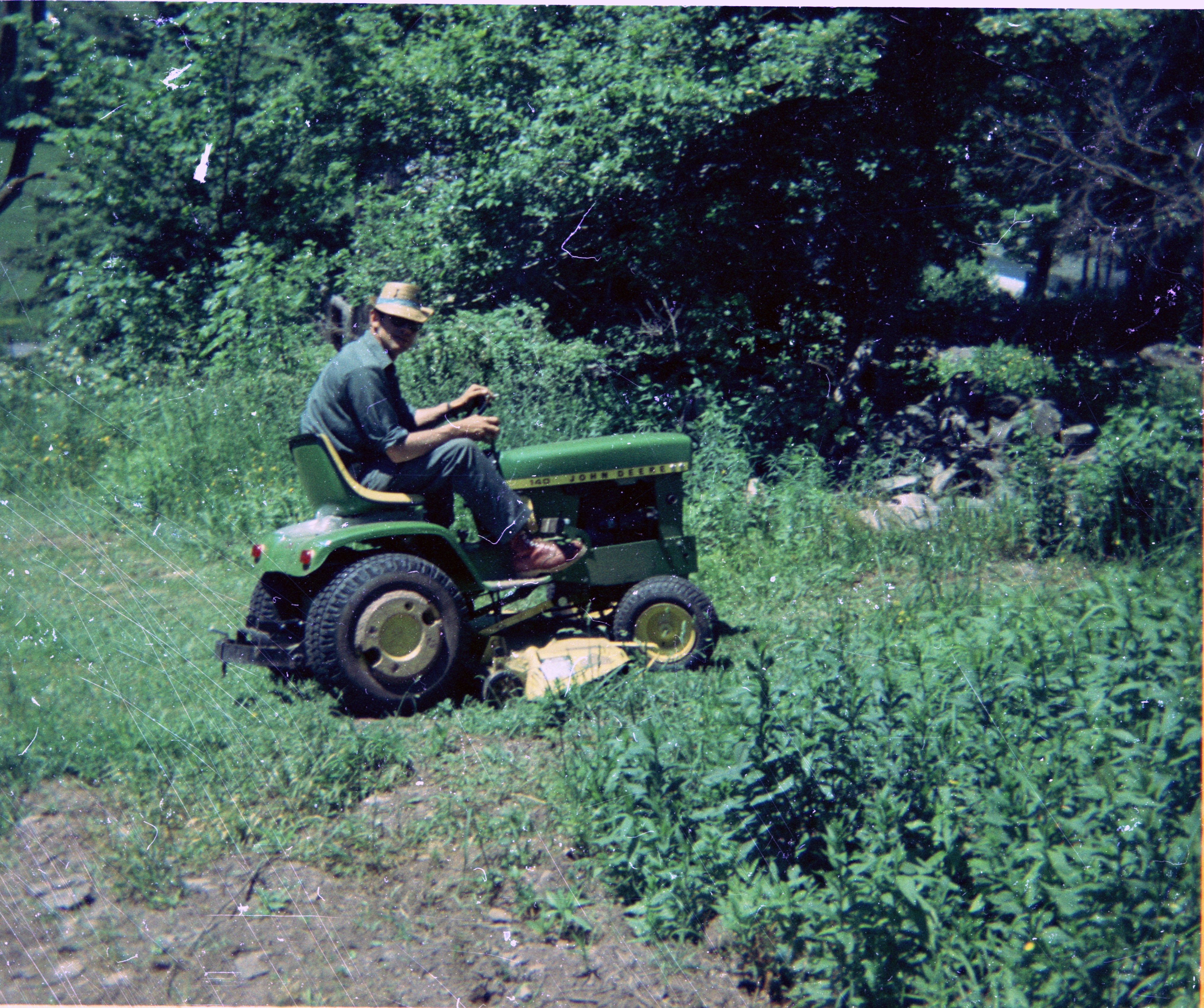
• January 31, 2023 - With all the wonderful entries in the parade, this is the one that stood out for me for very personal reasons. This John Deere 140 lawn tractor, restored by the Gabriel crew and driven by Braedon Rockefeller, was once owned by my dad, Charlie LaFever. I remembered back in 1974 I was using the tractor to haul some stuff out of the house. I parked it, went in the house for another load and came out just in time to see the tractor roll on its own across the front walk toward the stone wall that dropped onto the driveway. Fortunately, it came to a stop on a post and didn't make the trip over the wall. It got stuck on the wall and I couldn't get it moved until my dad came home to see his John Deere hung up on the wall and me in a total panic. He just burst out laughing and we rescued it in quick order. And in 1976, it was on this tractor that he won two tractor pulls during Bovina's celebration of the nation's Bicentennial. I still have the trophies he won.